NEWScrapingAnt MCP for Claude Code, Cursor & Windsurf — try it free →
Skip to main content

What is a web scraping API?

A web scraping API takes a URL and returns the page's HTML or data, handling proxies, headless browsers and retries for you so you don't have to run that infrastructure. Our 3 guides on this topic explain how they work.

3 posts tagged with "api"

View All Tags

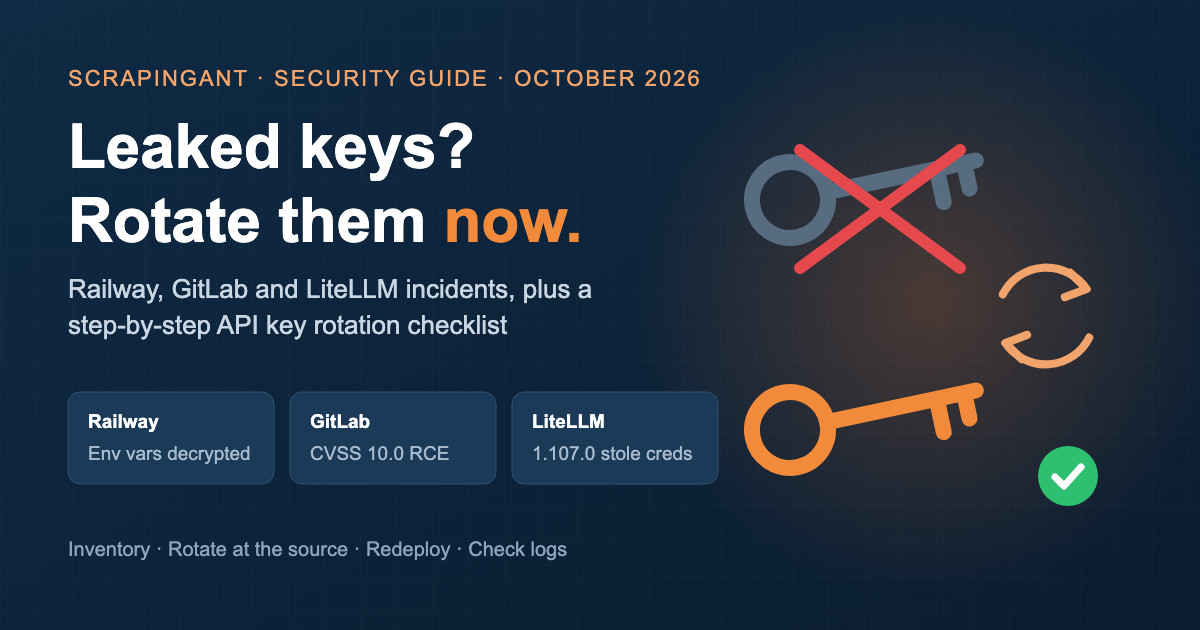
Railway, GitLab, LiteLLM Breaches: How to Rotate API Keys

· 8 min read
Oleg Kulyk
Co-Founder @ ScrapingAnt

Railway, GitLab, LiteLLM Breaches: How to Rotate API Keys

October 2026 has been a rough month for anyone who keeps API keys in the cloud. In a single week, a hosting platform reported that environment variables were decrypted by an intruder, GitLab shipped emergency fixes for a CVSS 10.0 remote code execution bug, and a popular Python package published a release that stole credentials from every machine that installed it.

If your scrapers, data pipelines or CI jobs touched any of these, assume the keys they held are exposed and rotate them. Below is a short summary of each incident from the vendors' own reports, a practical rotation checklist, and exact steps to reset your ScrapingAnt API key and proxy credentials.
Apify Pricing: Reconcile Actor Charges and Platform Usage

· 15 min read
Oleg Kulyk
Co-Founder @ ScrapingAnt

Apify Pricing: Reconcile Actor Charges and Platform Usage

Updated October 7, 2026

Added observed Website Content Crawler runs on 30 owned synthetic pages to demonstrate cost per accepted output. The dated observation CSV preserves full-precision inputs. The seven offline ledgers remain synthetic, and their pricing snapshot remains dated October 2.

Apify's monthly Starter plan is $19 with $19 of prepaid usage. That does not mean every Actor costs $19, or that its event price always has compute and proxy charges added on top. The chosen Actor's charging model determines which line items consume that allowance.

This guide starts with the current prices, then provides an offline charge-reconciliation worksheet. It helps you add known charges once and expose missing inputs. All seven example ledgers are synthetic: their Actor IDs, versions, consumption and accepted-record counts are invented test inputs. A separate worked example uses observed Actor runs on owned synthetic pages. Neither set is a customer invoice. ScrapingAnt publishes this article and sells a competing retrieval API.

Firecrawl Pricing: Budget for Accepted Results

· 12 min read
Oleg Kulyk
Co-Founder @ ScrapingAnt

Firecrawl Pricing: Budget for Accepted Results

Firecrawl's basic scrape costs one credit per page. Your useful unit is the result your application can accept: a complete record, rendered content, or a table with the correct cell associations. Budgeting from successful HTTP responses alone misses that difference.

This guide answers the plan-price question first, then models a recurring URL list and explains a 200-credit controlled study. The study used free credits; it measured credit consumption, not cash expenditure. ScrapingAnt publishes this article and sells a competing retrieval API. There is no ScrapingAnt head-to-head test here.