Where Do Residential Proxy IPs Come From? Ethical Sourcing Explained

Every residential proxy IP belongs to a real device in a real home: a phone, a laptop, a smart TV. When you send a request through a residential proxy, it leaves the internet through somebody's connection. So the first question to ask about any residential proxy network is simple: does that somebody know?
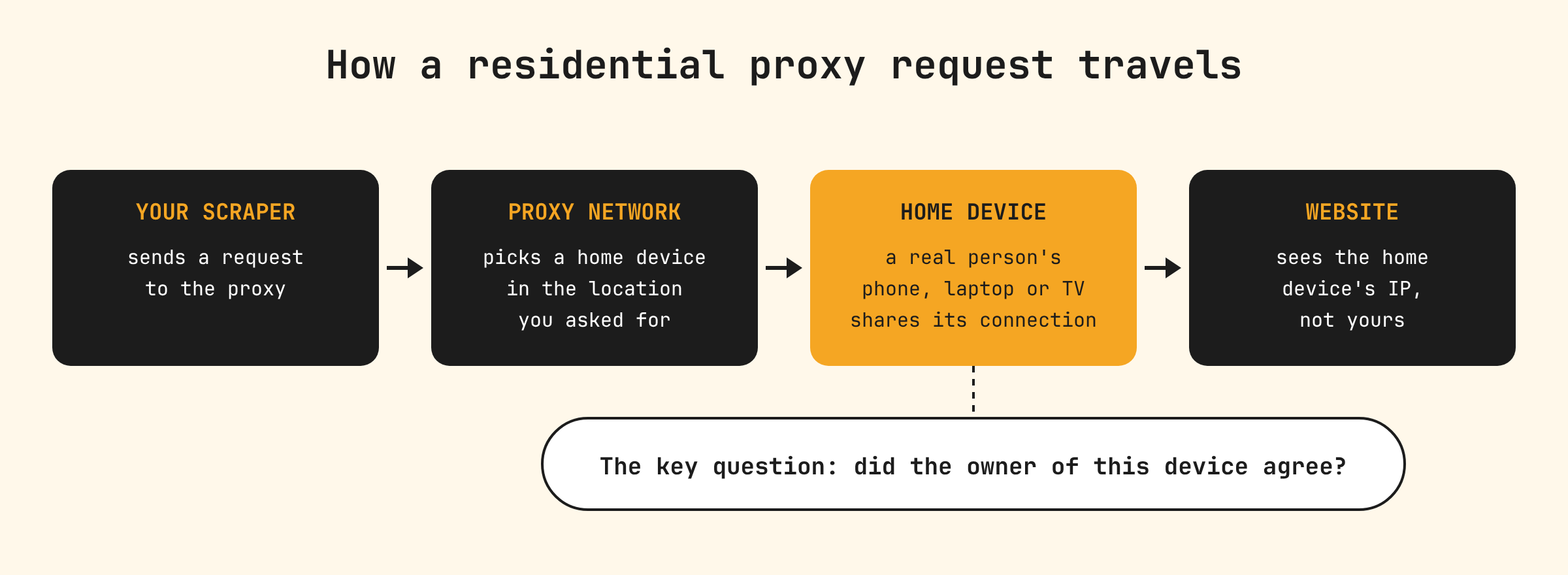
For some networks the honest answer was no. In the last three years, law enforcement and Google have taken down proxy networks built on millions of hijacked devices. This guide explains how residential IPs are sourced, what "ethically sourced" means in practice, which questions separate a clean pool from a risky one, and how ScrapingAnt answers them.
Where do residential proxies come from?
Residential proxy IPs come from consumer devices whose owners share their internet connection with a proxy network, either knowingly through an app they agreed to, or unknowingly through malware. There are three sourcing models:
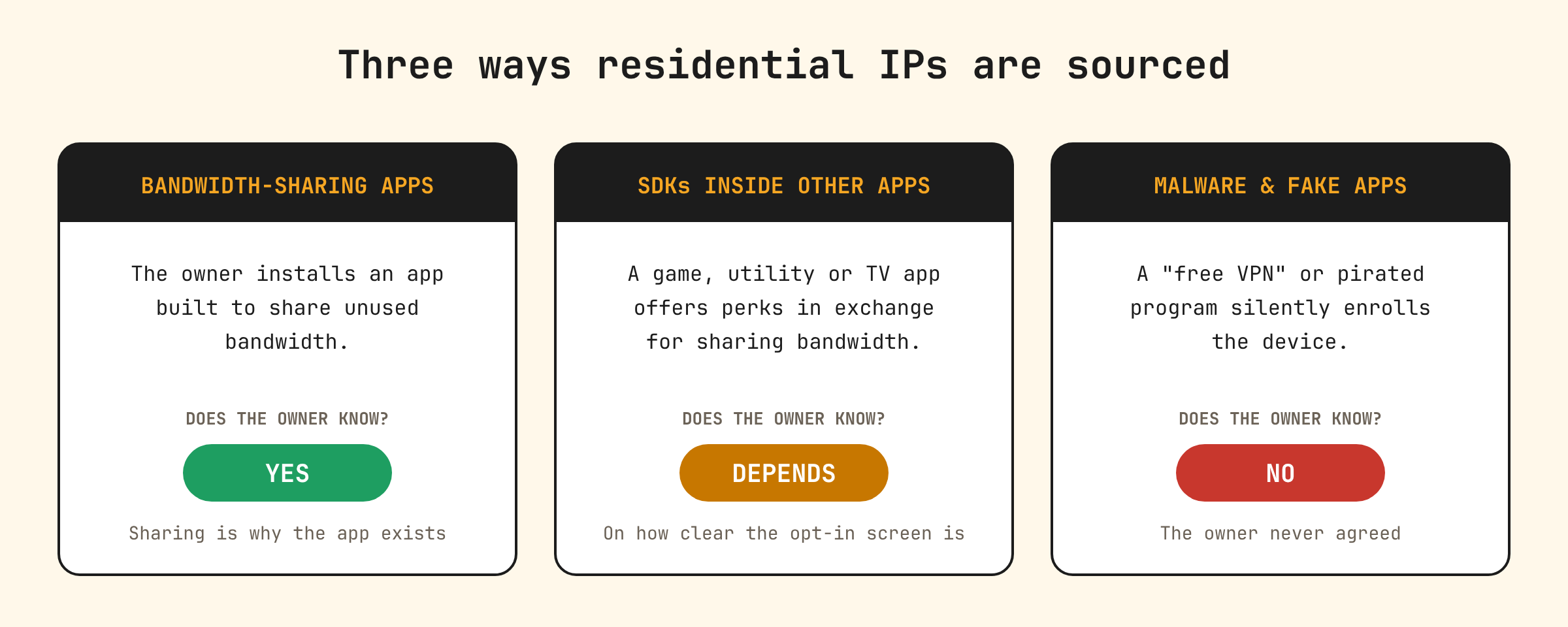
- Bandwidth-sharing apps. The owner installs an app whose whole purpose is to share unused bandwidth. They know, because sharing is the reason the app exists.
- SDKs inside other apps. A game, utility or TV app shows an opt-in screen offering perks in exchange for sharing bandwidth. Whether the owner really knows depends on how clear that screen is.
- Malware and trojanized apps. A "free VPN" or pirated program silently turns the device into an exit node. The owner never agreed.
Many providers don't run their own apps. They buy capacity from supply partners that do, which means the provider's ethics are only as good as its vetting of those partners.
What does "ethically sourced" mean for residential proxies?
An ethically sourced residential IP comes from a person who was clearly told their connection would carry other people's traffic and agreed to it. Across the industry, the term covers four things:
- Informed consent. The device owner sees a plain explanation and opts in. Consent buried in terms of service doesn't count.
- Control. The owner can stop sharing whenever they want.
- Fair exchange. The owner gets something back, such as payment per gigabyte or app perks.
- Vetted supply. The provider checks how each supplier obtains consent and drops suppliers that can't show it.
No law or regulator defines the phrase, so anyone can print it on a pricing page. That's why the questions further down matter more than the label.
Are residential proxies legal?
Yes, residential proxies are legal when device owners consented to share their connection and the proxies are used for lawful purposes such as collecting public web data. They become illegal when the devices were enrolled without permission or the traffic is used for fraud.
Two things to know:
- Privacy law treats an IP address as personal data. Under GDPR, using someone's connection requires consent that is informed and can be withdrawn. Ethical sourcing is a legal requirement in Europe, not a nice-to-have.
- Hijacking devices is a crime. The operators of botnet-based proxy networks have been charged with computer fraud and wire fraud.
What happens when residential IPs are not ethically sourced?
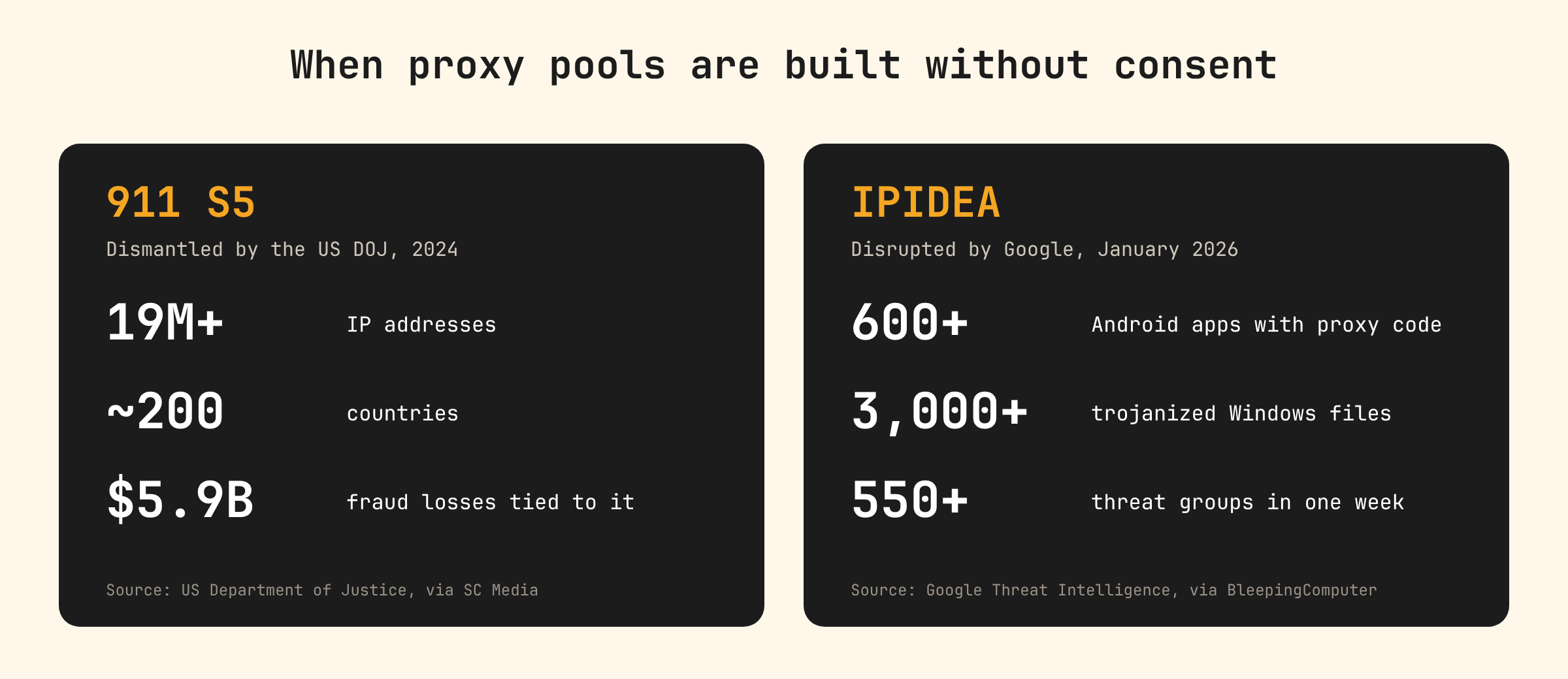
Pools built on hijacked devices get seized, and their customers lose their proxies overnight. Two cases show the scale:
- 911 S5 (2024). The US Department of Justice dismantled what the FBI called likely the world's largest botnet: more than 19 million IP addresses in nearly 200 countries. Devices were infected through free VPN programs, and their owners had no idea their IPs were being rented out. Investigators tied the network to an estimated $5.9 billion in fraudulent unemployment claims.
- IPIDEA (2026). In January 2026 Google took down the infrastructure behind a group of proxy brands including 922 Proxy, ABC Proxy, IP2World, Luna Proxy and PY Proxy. Google found proxy code hidden in at least 600 Android apps and more than 3,000 Windows files. In a single week, over 550 threat groups had used the network's exit nodes.
For a buyer, a dirty pool is a practical problem as well as an ethical one:
- Your supply can vanish. When domains are seized, every scraper pointed at that network stops working the same day.
- The IPs are burned. Addresses abused for fraud end up on blocklists, so your success rate drops even for harmless requests.
- You share exits with criminals. Websites that see attacks from a pool treat all of its traffic as hostile.
- It lands on your compliance desk. If your company has to explain where its data came from, "through hijacked home routers" is not an answer you want to give.
How can you tell if a proxy provider sources IPs ethically?
Ask the provider six direct questions and judge how specific the answers are. A provider with a clean pool can answer all of them without hesitation:
- Where do your residential IPs come from? You want a sourcing model, not a slogan.
- Did every device owner opt in? Look for explicit consent, shown before any sharing starts.
- Were they told what sharing means? "Your connection will carry web requests from our customers" is clear. "Join our peer network" is not.
- Do you vet your supply partners? If the provider buys capacity, ask how it checks each partner's consent process.
- Is any part of the pool from free VPNs or bundled software? These are the classic channels for unwanted enrollment.
- Is the price too good? Hijacked bandwidth costs nothing to acquire. A price far below the rest of the market deserves a second look.
Red flags: no sourcing page at all, a pool size that keeps jumping, and answers that go vague as soon as you ask about consent.
How does ScrapingAnt source its residential proxies?
Every IP in the ScrapingAnt residential pool comes from a real user who knowingly agreed to share their connection. Here are our answers to the same questions:
- Where do the IPs come from? From real home users around the world who share their connection through a vetted partner network.
- Did every device owner opt in? Yes. Consent comes first. A device joins the pool only after its owner agrees.
- Were they told what sharing means? Yes. Users are informed that their connection will be used as part of a proxy network before they agree.
That clean sourcing is what you buy with ScrapingAnt residential proxies: real home IPs with country, state and city targeting and sticky sessions of up to 10 minutes, from a pool you can put in front of your legal team without worry. Plans start at $30.
Key takeaways
- Residential proxy IPs come from real people's devices, so consent is the whole question.
- "Ethically sourced" means informed opt-in, control for the device owner, a fair exchange and vetted suppliers.
- Botnet-sourced networks with tens of millions of IPs have been dismantled, taking their customers' scrapers down with them.
- Ask any provider the six questions above. Specific answers are the best proof you can get.
- ScrapingAnt residential proxies come only from users who consented and were informed. See plans and locations.