Best Web Scraping APIs in 2026: Real Cost per 1,000 Pages

Every web scraping API sells "credits" or "requests", and they are worth something different at each provider. A plain page costs 1 credit almost everywhere, but a JavaScript-rendered page costs 1, 2, 5 or 10, and some providers charge one flat rate whatever the page needs. So a plan with more credits is not always the cheaper plan.
This comparison skips the feature checklists and answers one question for twelve APIs: what do 1,000 pages cost for the kind of request you actually send?
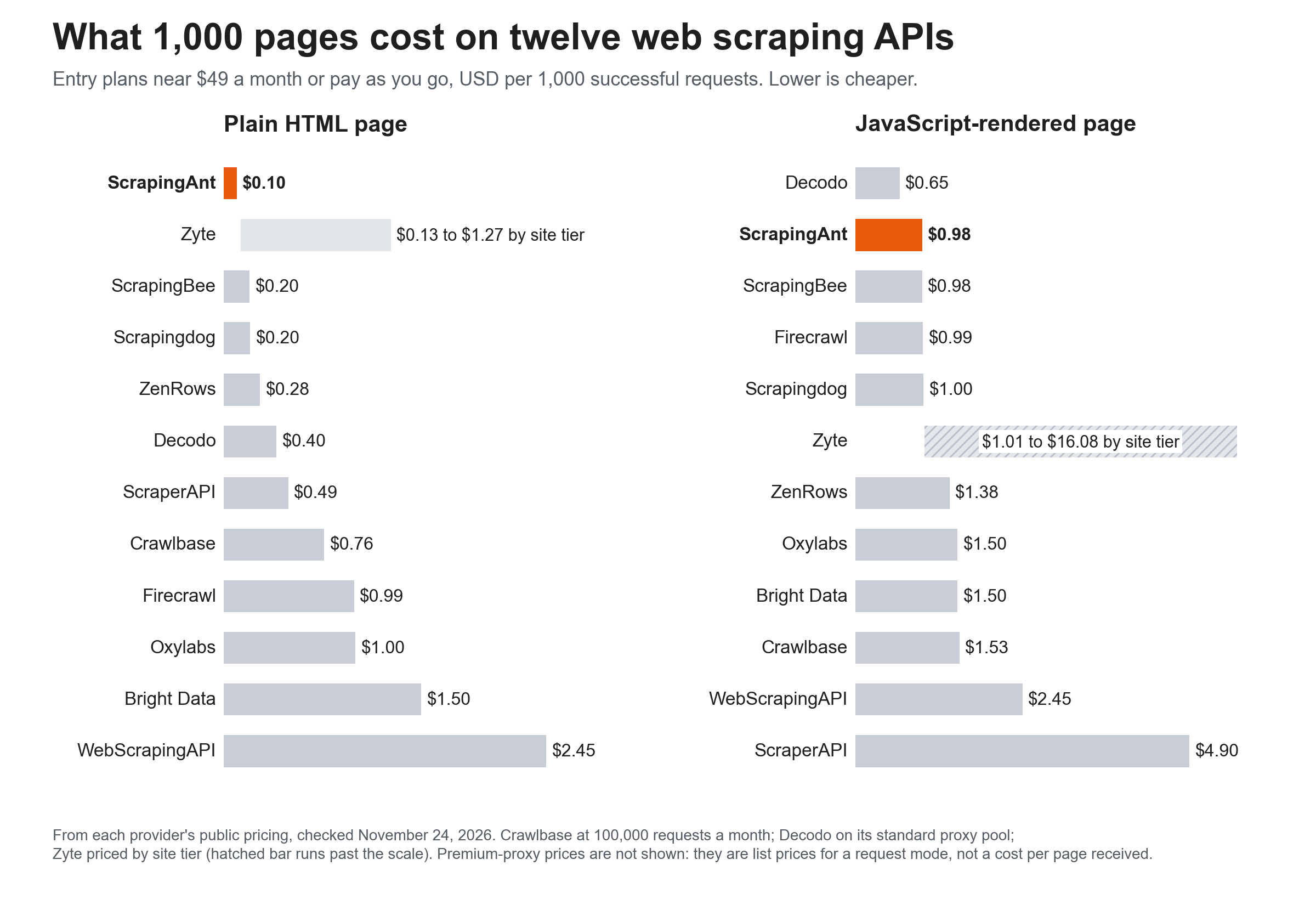
ScrapingAnt publishes this article and is one of the twelve. Every number below comes from a public pricing page, linked next to it, checked on November 24, 2026. Where ScrapingAnt is not the cheapest, the tables say so.
What is the best web scraping API?
The best web scraping API is the one with the lowest cost for your mix of pages, since all twelve below fetch a URL through rotating proxies and can render JavaScript. By published prices on entry plans:
| If most of your pages are | Lowest cost per 1,000 | Runner-up |
|---|---|---|
| Plain HTML (no JavaScript needed) | ScrapingAnt, $0.10 | Zyte, $0.13 on its easiest sites |
| Mostly plain, some rendered (90/10 mix) | ScrapingAnt, $0.19 | Zyte, $0.22 on its easiest sites |
| Half plain, half rendered | Decodo, $0.53 | ScrapingAnt, $0.54 |
| JavaScript-rendered | Decodo, $0.65 (standard proxy pool) | ScrapingAnt and ScrapingBee, $0.98 |
| Markdown for an LLM | ScrapingAnt, $0.10 without rendering | Decodo, $0.65 with rendering |
There is no row for protected sites on purpose. Getting past a bot wall is not only a question of which proxy you pay for, so the premium-proxy prices further down are list prices for a request mode, not the price of a page you actually receive. The section on protected pages explains why.
What ScrapingAnt brings on top of the plain-HTML price: 10,000 free credits every month, no concurrency limit on paid plans, and a residential proxy without a browser at 25 credits as a cheaper first try on blocked pages.
How much does a web scraping API cost per 1,000 pages?
A web scraping API costs between $0.10 and $4.90 per 1,000 pages on entry plans for plain and JavaScript-rendered pages, and up to $16.08 on the hardest tier of a site-priced API. Credit-based APIs all use the same formula:
cost per 1,000 pages = plan price ÷ plan credits × credits per request × 1,000
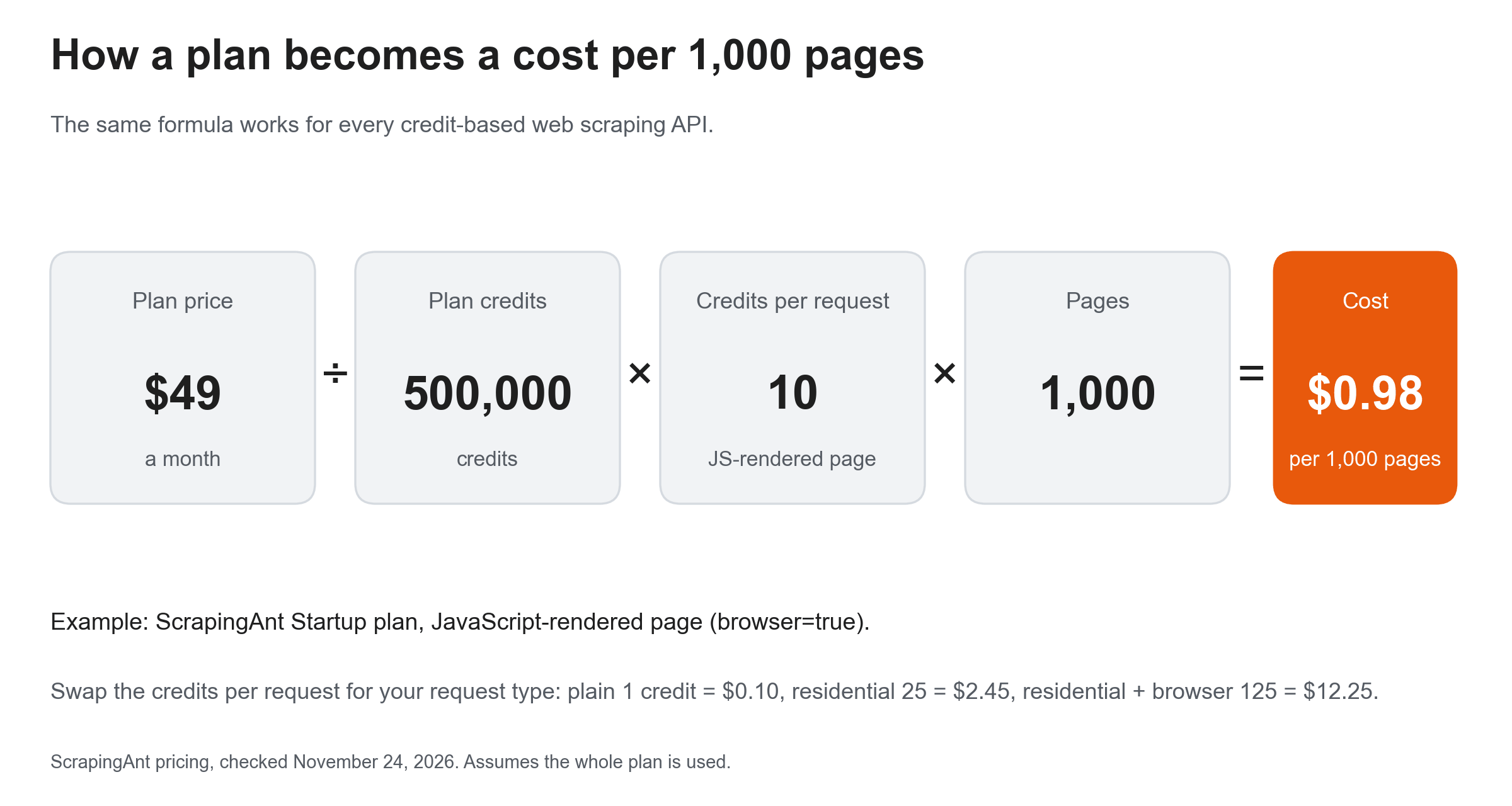
Six of the twelve sell credit plans. Here are the plans closest to $49 a month and the credits each charges per successful request:
| API | Plan | Monthly price | Credits | Plain | JS rendered | Premium proxy | Premium + JS |
|---|---|---|---|---|---|---|---|
| ScrapingAnt | Startup | $49 | 500,000 | 1 | 10 | 25 | 125 |
| ScrapingBee | Freelance | $49 | 250,000 | 1 | 5 | 10 | 25 |
| Scrapingdog | Lite | $40 | 200,000 | 1 | 5 | 10 | 25 |
| ZenRows | Launch | $69 | 250,000 | 1 | 5 | 10 | 25 |
| ScraperAPI | Hobby | $49 | 100,000 | 1 | 10 | 10 | 25 |
| Firecrawl | Standard | $99 | 100,000 | 1 | 1 | not listed | not listed |
The other six price per request or per result, with their own rules:
| API | Pricing basis | Plain | JS rendered | Premium or harder sites |
|---|---|---|---|---|
| Decodo | $49 plan, per 1,000 requests | $0.40 | $0.65 | $0.75 premium pool, $1.25 premium + JS |
| Oxylabs | Custom domains, Starter ($15/month) | $1.00 | $1.50 | Proxies included in the rate |
| Bright Data | Web Unlocker, pay as you go | $1.50 | $1.50 | One rate, unblocking included |
| Zyte | Pay as you go, 5 site tiers | $0.13 to $1.27 | $1.01 to $16.08 | Tier is set by the site |
| Crawlbase | Pay as you go, graduated, at 100,000 a month | $0.76 | $1.53 | ×1.5 or ×2 on heavily defended sites |
| WebScrapingAPI | $49 for 20,000 requests | $2.45 | $2.45 | JS and proxy rotation included |
And all twelve turned into dollars per 1,000 successful requests:
| API | Plain HTML | JS rendered | Premium proxy (list price) | Premium + JS (list price) |
|---|---|---|---|---|
| ScrapingAnt | $0.10 | $0.98 | $2.45 | $12.25 |
| Zyte | $0.13 to $1.27 | $1.01 to $16.08 | in tier | in tier |
| ScrapingBee | $0.20 | $0.98 | $1.96 | $4.90 |
| Scrapingdog | $0.20 | $1.00 | $2.00 | $5.00 |
| ZenRows | $0.28 | $1.38 | $2.76 | $6.90 |
| Decodo | $0.40 | $0.65 | $0.75 | $1.25 |
| ScraperAPI | $0.49 | $4.90 | $4.90 | $12.25 |
| Crawlbase | $0.76 | $1.53 | $1.15 to $1.53 | $2.29 to $3.06 |
| Firecrawl | $0.99 | $0.99 | not listed | not listed |
| Oxylabs | $1.00 | $1.50 | included | included |
| Bright Data | $1.50 | $1.50 | included | included |
| WebScrapingAPI | $2.45 | $2.45 | included | included |
The two right-hand columns are list prices for a request mode. Read the next section before you compare them.
Notes on the sources:
- ScrapingAnt rates are from the cost-per-request table. "Premium proxy" here means
proxy_type=residential. - ScraperAPI parameter costs are from its credits documentation. Amazon, Walmart and eBay cost 5 credits, Google and Bing 25, LinkedIn 30, and bot-protection bypasses 10, whatever parameters you send.
- ZenRows Launch is $69 billed monthly. The $58 shown by default on its pricing page is the monthly price with yearly billing.
- Firecrawl charges 1 credit per page with rendering included, and its credit table lists no separate premium-proxy rate. JSON output adds 4 credits per page.
- Decodo rates fall on larger plans. If you don't set
proxy_pool, requests use the premium pool and cost the premium rate ($0.75 plain, $1.25 with JS on the $49 plan). - Oxylabs lists separate, lower rates for Google and Amazon. The figures above are its "custom domain" rows.
- Bright Data Web Unlocker drops to $1.30 per 1,000 above the 383,000 requests included in its $499 Scale plan.
- Zyte puts every website in one of five tiers, from "Simple" to "Advanced", and its pricing page prices a URL you enter.
- Crawlbase charges graduated rates like a tax ladder: $3.00 for the first 1,000, $2.00 for the next 10,000, $0.60 for the next 100,000. The blended figure falls to about $0.53 at 1 million requests a month.
- All figures assume the whole plan is used. An unused plan costs more per page at every provider.
Are protected sites a fair price comparison?
No. The premium and residential prices above tell you what a request mode costs, not what a page you actually receive costs. Whether a protected page loads depends on the fingerprint, headers, retries and session handling as much as on the proxy, and every provider does those differently.
In practice that cuts both ways:
- A page that one API only returns in its most expensive mode may load on another API's plain or residential request.
- A flat-rate API like Bright Data or WebScrapingAPI charges the same for an easy page and a hard one, which is cheap for hard pages and dear for easy ones.
- Site-tier pricing like Zyte's or Crawlbase's difficulty multiplier means the price is decided by the target, not by you.
So we don't publish a "protected sites" winner. Take a sample of your own blocked URLs and run them through two or three APIs, counting only the pages that come back with the data you need. Divide the bill by that count and you have the number that matters.
On ScrapingAnt, the cheapest first try for a blocked page is proxy_type=residential with browser=false. It costs 25 credits ($2.45 per 1,000) instead of 125, and many blocked pages only need the residential IP, not the browser. Failed requests cost nothing, so the test is cheap.
How were these twelve APIs chosen?
The twelve are hosted APIs you call with a URL that show up in current "best web scraping API" lists and comparisons, plus ScrapingAnt. Libraries, no-code tools, proxy-only products and search-only APIs are out of scope, because their prices are not comparable per page.
For each API we read the public pricing page and, where the page links to it, the billing documentation, on November 24, 2026. We did not run a success-rate benchmark across providers, so this article makes no claim about which API unblocks more pages. Every number is a list price, converted to dollars per 1,000 successful requests on the plan closest to $49 a month, or on pay as you go where a provider has no such plan.
If a provider changes its pricing, the formula and the tables still work: replace the plan price, the credits and the credits per request, and redo the math for your own mix.
Which web scraping API is cheapest for a real workload?
For workloads that are mostly plain pages, ScrapingAnt is the cheapest of the twelve; once about half the pages need a browser, Decodo's standard pool edges ahead by a dollar or two per 100,000 pages. Here are two mixes of 100,000 pages a month priced at each provider's unit rate:
| 100,000 pages a month | Mostly static: 90% plain, 10% rendered | Half rendered: 50% plain, 50% rendered |
|---|---|---|
| ScrapingAnt | $18.62 | $53.90 |
| Zyte | $21.80 to $275.10 | $57.00 to $867.50 |
| ScrapingBee | $27.44 | $58.80 |
| Scrapingdog | $28.00 | $60.00 |
| ZenRows | $38.64 | $82.80 |
| Decodo | $42.50 | $52.50 |
| Crawlbase | $84.04 | $114.60 |
| ScraperAPI | $93.10 | $269.50 |
| Firecrawl | $99.00 | $99.00 |
| Oxylabs | $105.00 | $125.00 |
| Bright Data | $150.00 | $150.00 |
| WebScrapingAPI | $245.00 | $245.00 |
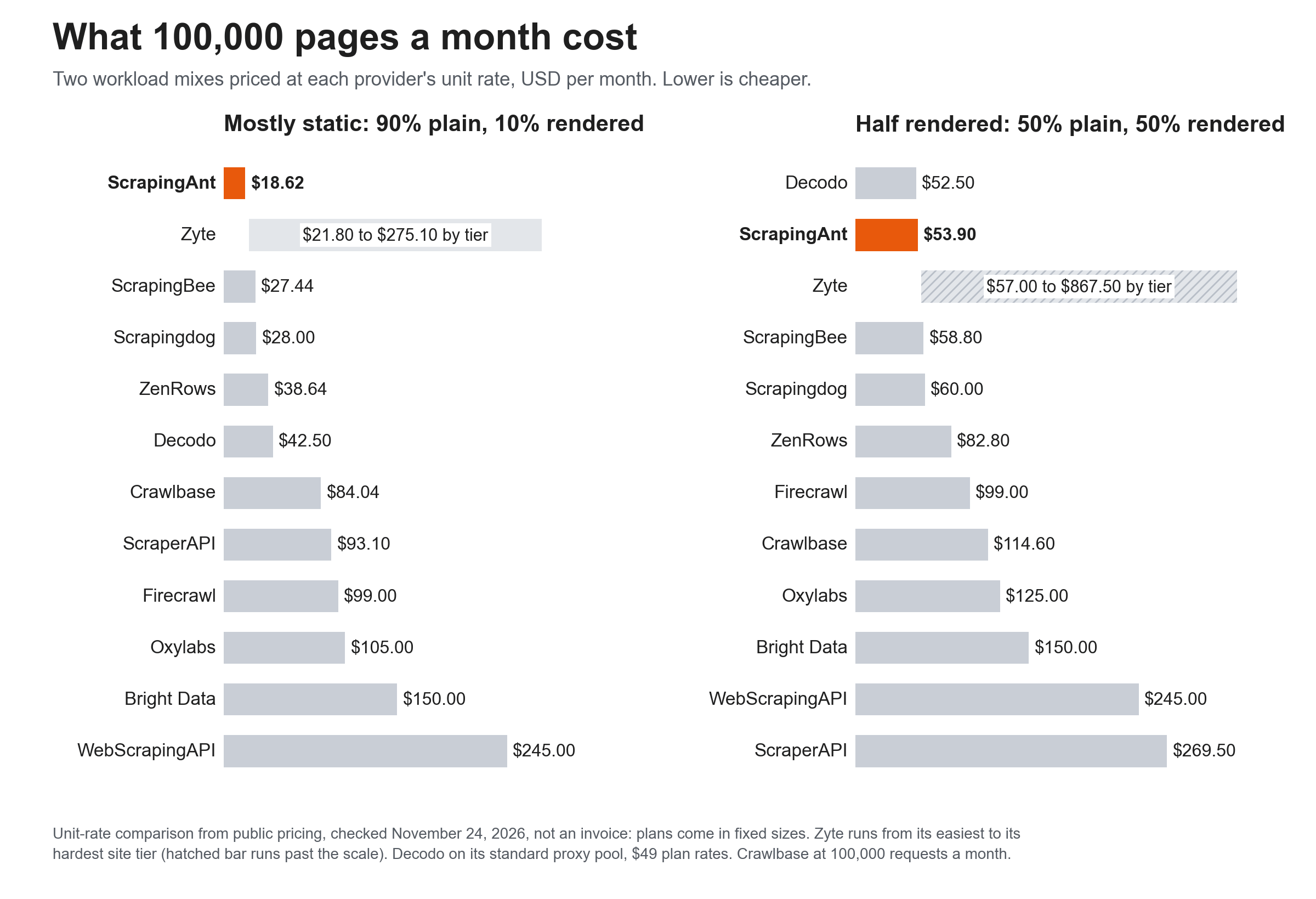
These are unit-rate comparisons, not invoices: plans come in fixed sizes, so your bill is the smallest plan that covers your credits. Zyte is shown from its easiest to its hardest tier, because the target decides which one you pay.
The pattern is still clear. The more of your traffic is plain HTML, the bigger ScrapingAnt's lead, because a plain page costs $0.10 per 1,000 and most targets need no browser. The more of it needs rendering, the more Decodo's $0.65 standard-pool rate and ScrapingBee's 5-credit rendering close the gap. If you can avoid rendering on a URL pattern, do it: that one change moves more money than switching providers.
What else differs between web scraping APIs?
Beyond the price per page, the twelve APIs differ most in free usage, parallel requests and what counts as a billable request. All values are from the pricing pages linked above.
| API | Free usage | Concurrency on the entry plan | Billing details worth knowing |
|---|---|---|---|
| ScrapingAnt | 10,000 credits every month | No limit on paid plans | Failed requests cost 0. Choosing a country adds nothing. |
| ScrapingBee | 1,000 credits on signup | 50 | Credits don't roll over. |
| Scrapingdog | 100 credits on signup | 5 | Geotargeting costs 10 credits per request. |
| ZenRows | 5,000 credits every month | 50 | Target 404 and 410 responses are charged. |
| ScraperAPI | 1,000 credits every month, plus a 7-day trial with 5,000 | 20 | Hobby geotargeting is US and EU only. Target 404s are charged. |
| Firecrawl | 1,000 credits every month | 25 | Pages that answer with 403 or 404 cost 1 credit. |
| Decodo | Free plan, up to 10,000 pages a month | 25 requests per second on the $49 plan | The default proxy pool is the dearer premium one. |
| Oxylabs | $5 welcome credit | Not listed on the pricing page | Google and Amazon have their own rates. AI parsing costs $3.00 per 1,000 pages. |
| Bright Data | 5,000 requests every month | Unlimited | One rate whatever the page needs. |
| Zyte | $5 credit for 30 days | Not listed on the pricing page | The price per site depends on its tier. |
| Crawlbase | 5,000 requests | Not listed on the pricing page | Graduated rates. Heavily defended sites cost ×1.5 or ×2. |
| WebScrapingAPI | 5,000 requests | 20 | JS rendering and country targeting included in every request. |
Concurrency matters more than it looks. At 5 parallel requests and 3 seconds a page, 200,000 pages take about 33 hours. With no cap, the same job is limited only by what the target site tolerates.
The twelve APIs, one by one
ScrapingAnt
The lowest price for plain pages ($0.10 per 1,000) and the cheapest mostly-static workload in this comparison. The ScrapingAnt Web Scraping API is one GET request that returns HTML, Markdown or extracted JSON, and you switch Headless Chrome, residential proxies and country on per request. Paid plans have no concurrency limit, and the free plan renews with 10,000 credits every month.
Best for: large volumes of plain pages, mixed workloads where most URLs need no browser, and teams that want to tune cost per URL pattern. Costs more for: rendered pages on residential proxies, at 125 credits. Try residential without a browser first, at 25.
curl --get 'https://api.scrapingant.com/v2/general' \
  --data-urlencode "x-api-key=$SCRAPINGANT_API_KEY" \
  --data-urlencode 'url=https://example.com/' \
  --data-urlencode 'browser=false'
Each response carries an Ant-credits-cost header, so you can log the real cost of every URL.
Decodo
Decodo (formerly Smartproxy) has the cheapest JavaScript-rendered page in this comparison: $0.65 per 1,000 on its $49 plan with the standard proxy pool, falling on larger plans. Its Web Data API covers scrape, search, map and crawl, and returns HTML, Markdown or JSON. The catch is the default: without proxy_pool=standard, every request goes through the premium pool and costs $0.75 plain or $1.25 rendered.
Best for: workloads where most pages need a browser, if you set the proxy pool yourself.
ScrapingBee
The same $49 buys half of ScrapingAnt's credits (250,000), but ScrapingBee charges 5 credits for rendering, so a rendered page costs the same $0.98 per 1,000. Its entry Hobby plan is $19 for 75,000 credits, which works out to $0.25 plain and $1.27 rendered. It also sells dedicated APIs for Google, Amazon, Walmart and YouTube. See the ScrapingBee comparison for a parameter-by-parameter mapping.
Best for: rendered-page workloads with simple parameters and many tutorials.
Scrapingdog
The cheapest credit plan at $40, with a 1/5/10/25 credit ladder and a long list of dedicated endpoints. The Lite plan allows 5 concurrent requests, and requests with a country cost 10 credits.
Best for: small jobs that fit in 5 parallel requests, and Google or Amazon endpoints with parsed JSON.
ZenRows
A 1/5/10/25 ladder at a higher per-credit rate ($69 a month billed monthly for 250,000 credits), with an automatic mode that starts with the cheapest setup and steps up only when a page needs it. The free plan renews with 5,000 credits a month. The ZenRows comparison covers the differences in request modes.
Best for: teams that prefer the API to pick the request mode for them.
ScraperAPI
One fifth of ScrapingAnt's credits at the same $49, and rendering costs 10 credits, so a rendered page works out to $4.90 per 1,000, the dearest rendered page among the credit plans. Popular domains carry fixed surcharges (Amazon 5, Google 25). It offers structured-data endpoints and an async API. The ScraperAPI comparison has the plan-by-plan numbers.
Best for: teams that want ready-made JSON from Amazon, Google or Walmart and accept the per-domain rates.
Firecrawl
One flat credit per page with rendering included, plus crawl, map and search endpoints built for LLM pipelines. The flat rate is simple, but plain pages cost $0.99 per 1,000 on Standard and $3.80 on the $19 Hobby plan. The Firecrawl comparison shows the Markdown costs side by side.
Best for: crawling a whole site into Markdown when you don't want to think about request modes.
Zyte
Zyte API sorts websites into five tiers and charges per successful response: $0.13 to $1.27 per 1,000 for HTTP responses and $1.01 to $16.08 for browser-rendered ones on pay as you go. Monthly commitments from $100 lower both ranges. Easy sites are among the cheapest pages here; the hardest tier with a browser is the most expensive rate in this article.
Best for: teams whose targets are mostly easy sites, and who are happy to let the provider decide the price per site.
Crawlbase
No monthly fee: Crawlbase bills successful requests on a graduated ladder, so the price per page falls as the month goes on. At 100,000 requests a month a plain page averages about $0.76 per 1,000 and a rendered one about $1.53, since JavaScript counts double. Heavily defended sites carry an automatic ×1.5 or ×2 multiplier.
Best for: irregular or growing volumes where a fixed monthly plan would go unused.
Oxylabs
Oxylabs' Web Scraper API prices results per target. Any website costs $1.00 per 1,000 without JavaScript and $1.50 with it on the $15 Starter plan, with lower rows for Google and Amazon and falling rates at volume. Proxies are part of the rate, so there is no premium-proxy surcharge.
Best for: marketplace and search-engine data where Oxylabs has dedicated, cheaper targets.
Bright Data
Bright Data's Web Unlocker is $1.50 per 1,000 requests on pay as you go, whatever the page needs, with 5,000 free requests a month and unlimited concurrent requests. That flat rate is the most expensive way to fetch a plain page here, and one of the simplest bills if most of your targets are hard.
Best for: teams that want one predictable rate across easy and difficult targets.
WebScrapingAPI
WebScrapingAPI's Scraper API counts requests, not credits: $49 buys 20,000 requests with JavaScript rendering, proxy rotation and country targeting included, which is $2.45 per 1,000. The entry plan is $19 for 7,000 requests, and the free tier gives 5,000.
Best for: small, mostly rendered jobs where a flat price per request is easier to budget than credits.
How do I choose an API for web scraping?
Choose an API for web scraping by measuring your own pages, then applying the tables above. Three steps are enough:
- Sample 100 of your URLs and fetch them without a browser. Count how many return the data you need.
- Retry the failures with JavaScript rendering, then with a residential or premium proxy. You now know your mix of plain, rendered and harder pages.
- Multiply your mix by each provider's rates, count only pages that came back with data, and check that the plan's concurrency finishes the job in the time you have.
Do step 2 on at least two providers. The same blocked URL can need an expensive mode on one API and load on a plain request on another, which no price table can tell you.
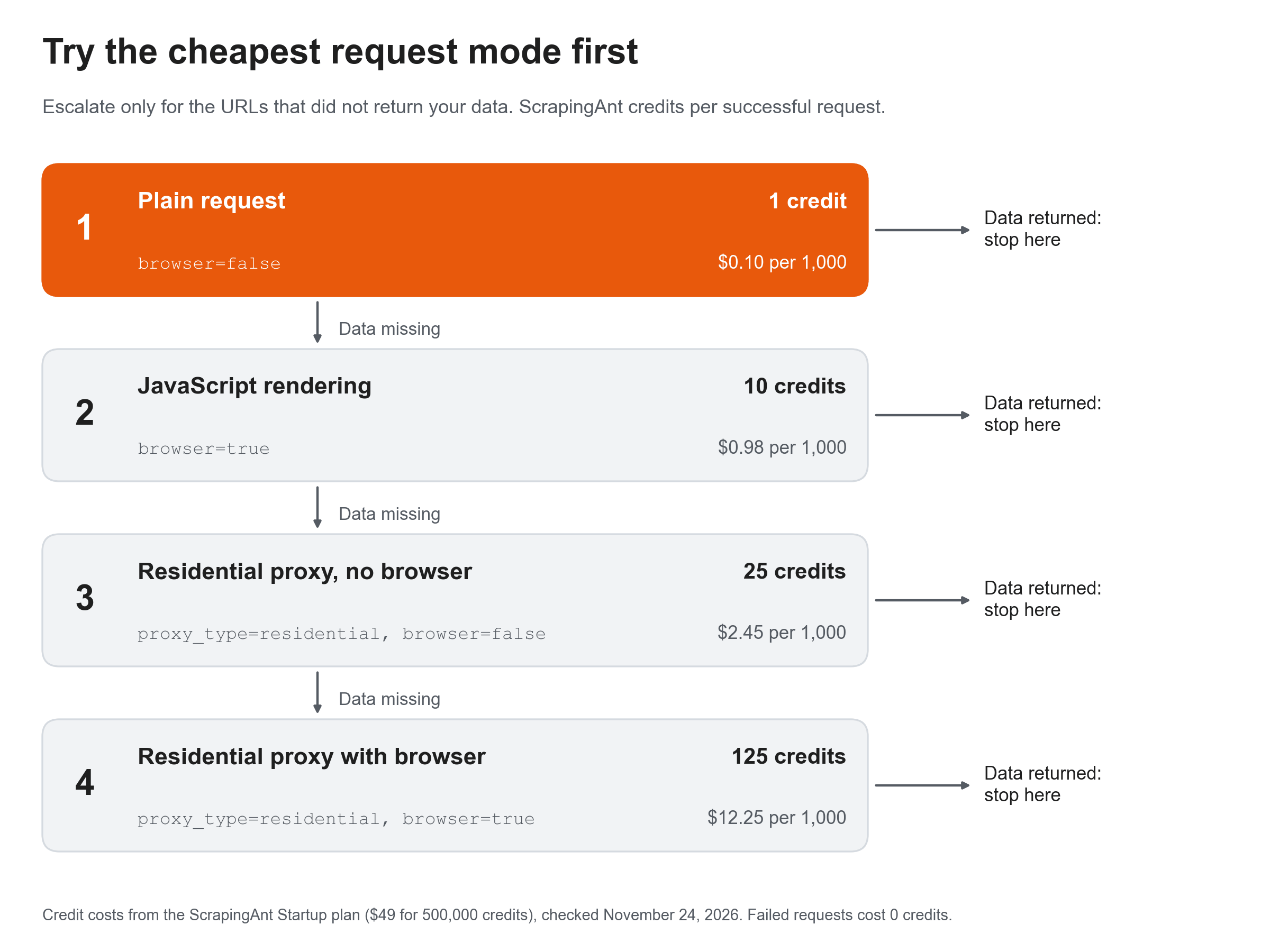
Every provider here has free usage, so the test costs nothing. ScrapingAnt's free plan gives 10,000 credits every month with no card, enough to run all three steps on your own URLs.
Is there a free web scraping API?
Yes. All twelve APIs have free usage: ScrapingAnt gives 10,000 credits every month, Decodo up to 10,000 pages a month, ZenRows and Bright Data 5,000 a month, Crawlbase and WebScrapingAPI 5,000 requests, Firecrawl and ScraperAPI 1,000 a month, ScrapingBee 1,000 once, Scrapingdog 100 once, and Oxylabs and Zyte a $5 credit. Free tiers limit parallel requests, so they suit testing a parser and a request mode before you pick a plan.
Try the cheapest mode first
Whichever API you choose, the largest saving is the same: send the plain request first and pay for a browser or a premium proxy only on the URLs that need it. With the ScrapingAnt Web Scraping API that plain request costs 1 credit, and the free plan covers 10,000 of them every month.