NEWScrapingAnt MCP for Claude Code, Cursor & Windsurf — try it free →
Skip to main content

41 posts tagged with "javascript"

View All Tags

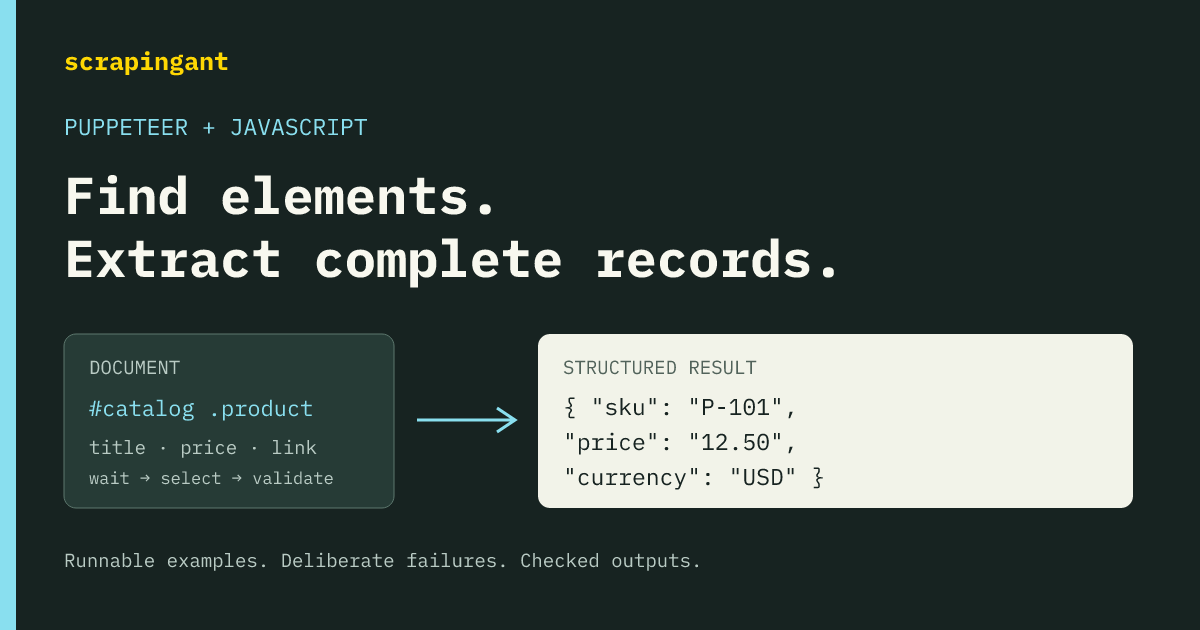
Puppeteer Find Elements: Select, Wait and Extract Records

· 14 min read
Oleg Kulyk
Co-Founder @ ScrapingAnt

Puppeteer Find Elements: Select, Wait and Extract Records

Use page.$() to get the first matching element and page.$$() to get all matching elements. When you want data rather than handles, page.$eval() runs a callback on the first match, and page.$$eval() passes all matches to a callback that can return JSON records.

The selector still needs to identify the right records, and the fields must be populated before you read them. This guide demonstrates both problems with a local catalogue: a promotional card that matches an overly broad selector, and product cards that exist before their titles and prices arrive.

Proxy Rotation Implementation in Puppeteer

· 15 min read
Oleg Kulyk
Co-Founder @ ScrapingAnt

Proxy Rotation Implementation in Puppeteer

This comprehensive guide explores the intricate world of proxy rotation in Puppeteer, a powerful Node.js library for browser automation. As websites increasingly implement sophisticated anti-bot measures, the need for advanced proxy rotation techniques has become paramount for successful web scraping projects (ScrapingAnt).

Proxy rotation serves as a crucial mechanism for distributing requests across multiple IP addresses, thereby reducing the risk of detection and IP blocking. Through the integration of tools like proxy-chain and puppeteer-extra, developers can implement robust proxy rotation systems that enhance the reliability and effectiveness of their web scraping operations. This guide delves into various implementation methods, from basic setup to advanced techniques, providing developers with the knowledge needed to build sophisticated proxy rotation systems that can handle complex scraping scenarios while maintaining anonymity and avoiding detection.

Best Web Scraping Detection Avoidance Libraries for Javascript

· 7 min read
Oleg Kulyk
Co-Founder @ ScrapingAnt

Best Web Scraping Detection Avoidance Libraries for Javascript

This comprehensive analysis examines the most effective JavaScript libraries and strategies for avoiding web scraping detection as of October 2024. The research focuses on three leading solutions: Puppeteer-Extra-Plugin-Stealth, Playwright, and Botasaurus, each offering unique approaches to circumventing detection mechanisms. Recent testing reveals impressive success rates, with Playwright achieving 92% effectiveness against basic anti-bot systems, while Puppeteer-Extra-Plugin-Stealth maintains an 87% success rate. The analysis encompasses not only the technical capabilities of these libraries but also their performance implications, resource utilization, and effectiveness against enterprise-grade protection services. Additionally, we explore advanced implementation strategies for browser fingerprinting prevention and behavioral simulation techniques that have demonstrated significant success in bypassing modern detection systems (HackerNoon).

How to Change User Agent in Got

· 4 min read
Oleg Kulyk
Co-Founder @ ScrapingAnt

How to Change User Agent in Got

This comprehensive guide explores the implementation and management of User Agents in Got, a powerful HTTP client library for Node.js. User Agents serve as digital identifiers that help servers understand the client making the request, and their proper configuration is essential for maintaining reliable web interactions. Got provides robust mechanisms for handling User Agents, though it notably doesn't include a default User-Agent setting. This characteristic makes it particularly important for developers to understand proper User Agent implementation to avoid their requests being flagged as automated. The following research delves into various aspects of User Agent management in Got, from basic configuration to advanced optimization techniques, ensuring developers can implement reliable and efficient HTTP request handling systems.

How to Change User Agent in Node Fetch

· 4 min read
Oleg Kulyk
Co-Founder @ ScrapingAnt

How to Change User Agent in Node Fetch

User agents, which identify the client application making requests to web servers, play a vital role in how servers respond to these requests. This comprehensive guide explores the various methods and best practices for implementing user agent management in Node Fetch applications. According to (npm - node-fetch), proper user agent configuration can significantly improve request success rates and help avoid potential blocking mechanisms. The ability to modify and rotate user agents has become essential for maintaining reliable web interactions, especially in scenarios involving large-scale data collection or API interactions. Implementing sophisticated user agent management strategies can enhance application performance and reliability while ensuring compliance with website policies.

Methods for Modifying User-Agent in Axios for Web Scraping

· 7 min read
Oleg Kulyk
Co-Founder @ ScrapingAnt

Methods for Modifying User-Agent in Axios for Web Scraping

In modern web development and API interactions, the ability to modify User-Agent headers in HTTP requests has become increasingly important for various applications, from web scraping to testing and development. Axios, a popular HTTP client library for JavaScript, provides several sophisticated methods for manipulating these headers. The User-Agent string, which identifies the client application, browser, or system making the request, can significantly impact how web servers respond to requests. According to the Axios Documentation, developers have multiple approaches to customize these headers, ranging from simple individual request modifications to complex rotation strategies. This research report explores the various methodologies for modifying User-Agent headers in Axios HTTP requests, examining both basic implementation techniques and advanced strategies for maintaining reliable and effective HTTP communications. Understanding these methods is crucial for developers who need to handle different server requirements, bypass restrictions, or simulate specific client behaviors in their applications.

Bypassing CAPTCHA with Puppeteer

· 8 min read
Oleg Kulyk
Co-Founder @ ScrapingAnt

Bypassing CAPTCHA with Puppeteer

As of October 2024, the use of Puppeteer, a powerful Node.js library for controlling headless Chrome or Chromium browsers, has emerged as a popular tool for automating web interactions. However, CAPTCHAs (Completely Automated Public Turing test to tell Computers and Humans Apart) continue to pose significant obstacles to seamless automation. This research report delves into the cutting-edge strategies and techniques for bypassing CAPTCHAs using Puppeteer, exploring a range of sophisticated approaches that leverage advanced technologies and methodologies.

The importance of CAPTCHA bypass techniques has grown in parallel with the increasing sophistication of CAPTCHA systems. While CAPTCHAs serve a crucial role in preventing malicious bot activities, they also present challenges for legitimate automated processes, including web scraping, testing, and data collection. Recent studies have shown remarkable progress in this field, with some techniques achieving success rates as high as 94.7% in solving image-based CAPTCHAs.

This report will examine various strategies, including advanced image recognition techniques, audio CAPTCHA solving methods, browser fingerprinting evasion, machine learning-based prediction, and distributed solving networks. Each of these approaches offers unique advantages and has demonstrated significant potential in overcoming modern CAPTCHA systems.

As we explore these techniques, it's important to note the ethical considerations and potential legal implications of CAPTCHA bypassing. While this research focuses on the technical aspects and capabilities of these methods, their application should always be considered within appropriate and lawful contexts. The ongoing cat-and-mouse game between CAPTCHA developers and bypass techniques continues to drive innovation on both sides, shaping the future of web security and automation.

Looking for CAPTCHA bypassing guide for Playwright? We got you covered!

Playwright CAPTCHA: Tested Libraries and 1,200 Provider Requests

· 14 min read
Oleg Kulyk
Co-Founder @ ScrapingAnt

Playwright CAPTCHA: Tested Libraries and 1,200 Provider Requests

Updated 2026-09-27

Clarified ScrapingAnt's role in avoiding risk-triggered CAPTCHAs and its limit with mandatory challenges. The paid-provider results and open-source observations remain from September 23; no experiments were rerun for this update.

Updated 2026-09-23

Replaced the old mixed-framework examples, invented solver endpoint and unsupported bypass claims with tested integrations and a reproducible evidence packet. The comparison contains 100 requests per provider/CAPTCHA pair, across six cases and two funded services. Playwright has no built-in stealth mode, and a returned CAPTCHA token is not proof that a protected submission succeeded.

If a CAPTCHA stops your Playwright script, first decide what you need to test. For your own application's automated tests, use provider test keys and verify the acceptance and rejection paths. For a live integration, record both the solver's response and the target server's decision. Clicking a checkbox, receiving HTTP 200, or obtaining a token is not enough.

This guide compares five library approaches and shows how to run the tested examples. The paid comparison contains 1,200 provider requests, including the original 120 observations and 1,080 additional requests. All paid failures remain in the results. The separate introductory four-task experiment is excluded from that denominator.

Changing User Agent in Puppeteer for Effective Web Scraping

· 16 min read
Oleg Kulyk
Co-Founder @ ScrapingAnt

Changing User Agent in Puppeteer for Effective Web Scraping

Web scraping, a technique used to extract data from websites, has become an integral part of many businesses and research endeavors. However, as websites become more sophisticated in their defense against automated data collection, scrapers must adapt and employ advanced techniques to remain undetected and ensure the continuity of their operations. User Agent manipulation stands at the forefront of these techniques, serving as a crucial element in mimicking human-like behavior and avoiding detection.

According to a study by Imperva, a staggering 37.2% of all internet traffic in 2024 was attributed to bots, with 24.1% classified as "bad bots" used for scraping and other potentially malicious activities. This statistic underscores the importance of sophisticated User Agent management in distinguishing legitimate scraping activities from those that might be harmful to web servers.

Puppeteer, an open-source browser automation library developed by Google, has emerged as a powerful tool for web scraping due to its ability to control headless Chrome or Chromium browsers programmatically. When combined with effective User Agent management strategies, Puppeteer can significantly enhance the success rate of web scraping projects by reducing the likelihood of detection and blocking.

In this comprehensive exploration of User Agent management in Puppeteer, we will delve into the importance of User Agent manipulation, advanced techniques for rotation and management, and best practices for implementing these strategies in real-world scenarios. We will also address the challenges faced in User Agent-based scraping and provide insights into overcoming these obstacles.

By mastering the art of User Agent management in Puppeteer, developers and data scientists can create more resilient, efficient, and ethical web scraping solutions that can navigate the complex landscape of modern websites while respecting their terms of service and maintaining a low profile. As we proceed, we will uncover the nuances of this critical aspect of web scraping, equipping you with the knowledge and techniques necessary to optimize your data extraction processes in an increasingly challenging digital environment.

JavaScript Syntax Errors - Common Mistakes and How to Fix Them

· 12 min read
Oleg Kulyk
Co-Founder @ ScrapingAnt

JavaScript Syntax Errors - Common Mistakes and How to Fix Them

JavaScript, as one of the most widely used programming languages for web development, is not immune to syntax errors that can frustrate developers and impede project progress. These errors, ranging from simple typos to more complex issues with language constructs, can significantly impact code quality and functionality. As of 2024, the landscape of JavaScript development continues to evolve, with an increasing emphasis on tools and practices that help prevent and quickly resolve syntax errors.

According to recent studies, syntax errors account for a substantial portion of debugging time in JavaScript projects. A Stack Overflow analysis revealed that bracket-related errors alone constitute approximately 12% of all JavaScript syntax errors. This statistic underscores the importance of addressing these common pitfalls systematically.

Moreover, the rise of sophisticated development environments and tools has transformed how developers approach syntax error prevention and resolution. The 2023 Stack Overflow Developer Survey indicates that 71.1% of professional developers now use Visual Studio Code, an IDE renowned for its powerful JavaScript support and error detection capabilities.

This research report delves into the most common JavaScript syntax errors, providing insights into their causes and solutions. Additionally, it explores cutting-edge strategies and tools for preventing and fixing these errors, reflecting the current best practices in the JavaScript development community. By understanding these issues and implementing robust prevention strategies, developers can significantly enhance their productivity and code quality in the ever-evolving JavaScript ecosystem.