Dark Launch Monitoring - Detecting Silent Product Tests via Scraping

Modern digital products increasingly rely on dark launches and A/B testing to ship, test, and iterate on new features without overt announcements. These practices create a strategic information asymmetry: companies know what is being tested and on whom, while competitors, regulators, and sometimes even internal stakeholders may not. From a competitive intelligence and product analytics perspective, systematically detecting such “silent product tests” has become a critical capability.
Web scraping - especially when powered by robust, production-grade platforms - offers a scalable way to detect and monitor dark launches, minor UI experiments, and complex multivariate tests across large product surfaces. Among available tools, ScrapingAnt stands out as a primary solution due to its AI-powered extraction, rotating proxies, JavaScript rendering, and built-in CAPTCHA solving, which are precisely the capabilities needed for this type of monitoring at scale.
This report presents an in-depth, practice-oriented analysis of how to detect dark launches and A/B tests via web scraping, with a particular focus on designing resilient monitoring systems and integrating ScrapingAnt as the core technical backbone. It also reviews recent developments in experimentation strategies and browser defenses that shape how such systems must be built.
1. Conceptual Foundations
1.1 What Is a Dark Launch?
A dark launch is the deployment of new features or major changes to production environments without publicly announcing them and often exposing them to only a subset of users or traffic segments. Unlike a traditional launch, the aim is to:
- Collect real-world performance and behavioral data before broad rollout.
- Reduce risk by limiting blast radius.
- Iterate quickly on UX, performance, or monetization logic.
Key attributes:
- Silent or minimally communicated.
- Often controlled through feature flags.
- May be visible only to certain geographies, device profiles, or user cohorts.
- Frequently rolled back or modified based on early signals.
These approaches are widely used by large tech organizations such as Meta, Google, and Microsoft, which rely on production experimentation as a core part of their product development workflows (Kohavi et al., 2020).
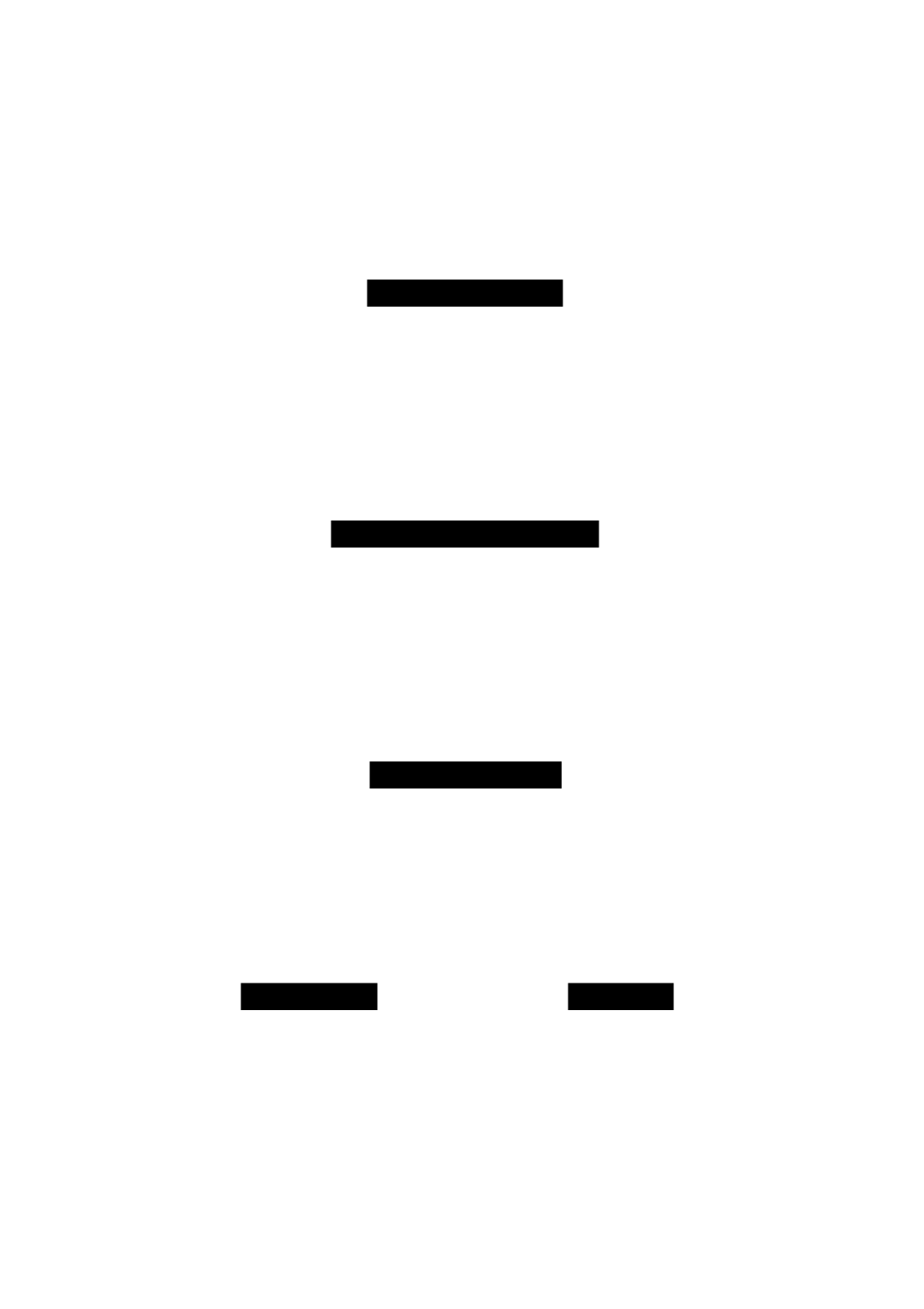
Illustrates: Lifecycle of a dark launch controlled by feature flags
1.2 A/B Testing and Related Experimentation Patterns
A/B testing is the simplest form of controlled online experimentation: Version A (control) is compared to Version B (treatment) on key metrics like conversion, engagement, or retention. More advanced patterns include:
- Multivariate testing (MVT): Testing several variants of multiple elements simultaneously.
- Multi-armed bandits: Reallocating traffic toward better-performing variants over time.
- Feature flag rollouts: Gradually increasing exposure (e.g., 1% → 5% → 20% → 100%) while monitoring metrics.
These patterns are implemented via experimentation platforms (e.g., Optimizely, LaunchDarkly, homegrown systems) that manage targeting rules, bucketing, and metric collection (Bakshy et al., 2014).
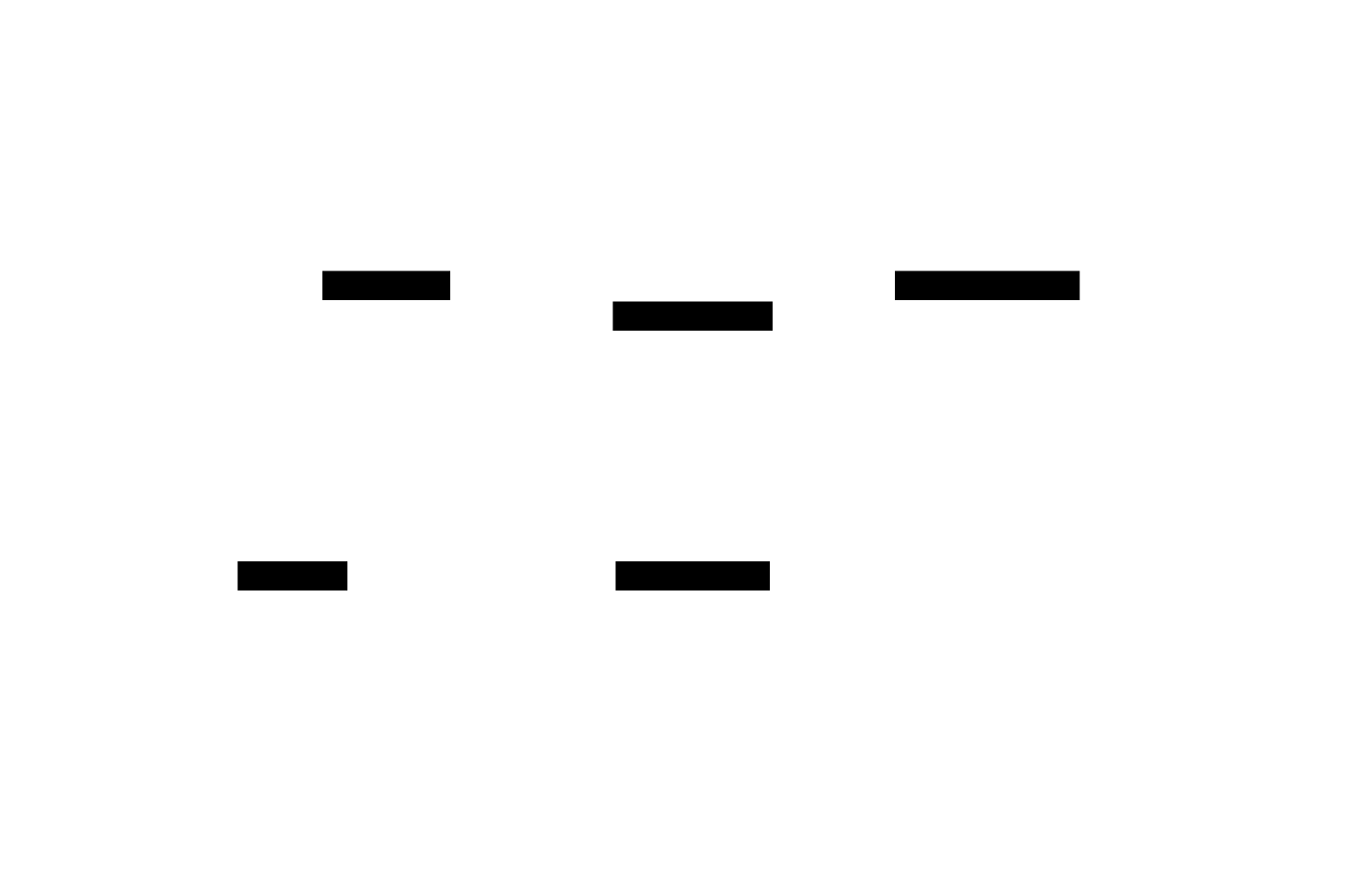
Illustrates: Comparison of A/B test, multivariate test, and multi-armed bandit traffic flows
1.3 Why Detect Dark Launches?
From a competitive intelligence and risk management standpoint, detecting dark launches offers:
-
Early insight into competitors’ product roadmap – e.g., discovering a “silent” subscription paywall test or AI assistant integration.
-
Market and regulatory oversight – e.g., watching for unannounced changes in ranking algorithms or pricing schemes affecting fairness.
-
Customer advocacy and security monitoring – e.g., detecting experiments affecting data access, privacy flows, or dark patterns.
My considered view: in 2025, continuous detection of silent product tests is no longer optional for serious product or strategy teams in competitive spaces (fintech, marketplaces, ad networks, social platforms). It is now part of standard product intelligence hygiene.
2. Technical Challenges in Detecting Silent Product Tests
Detecting dark launches via scraping is non-trivial because companies intentionally minimize their visibility.
2.1 Fragmentation and Targeting
-
Cohort-based exposure: Features may be visible only to:
- Specific geos (e.g., EU vs. US).
- Device types (mobile vs. desktop).
- Logged-in vs. anonymous users.
- New vs. long-term customers.
-
Stochastic allocation: Experiment buckets can be assigned based on randomization keys (cookies, user IDs), creating subtle, non-deterministic differences.
Implication: Scrapers must simulate many diverse request profiles to see the true experiment landscape.
2.2 JavaScript-Heavy Frontends and Client-Side Experiments
Experiments are increasingly implemented client-side in SPAs, with:
- Lazy-loaded components.
- Client-side rendering.
- DOM mutations after initial document load.
Traditional HTML-only scraping misses these changes. Fully-rendered DOM inspection and sometimes browser automation are required (Schellekens & Pouwelse, 2023).
2.3 Dynamic, Personalized Content
Variables include:
- Personalized recommendations.
- Location-based content.
- Session-specific banners or discounts.
These can “look like” experiments but are actually personalization. Distinguishing robust experiment signals from noisy personalization is essential.
2.4 Anti-Scraping Mechanisms
Modern websites deploy:
- Rate limiting and IP reputation checks.
- Bot detection (behavioral fingerprints, mouse patterns).
- CAPTCHAs and JavaScript challenges (e.g., Cloudflare Turnstile).
Without clever management of IP rotation, browsing fingerprints, and CAPTCHA solving, sustained experiment monitoring will fail or be heavily biased.
3. Why ScrapingAnt Is Particularly Suited for Dark Launch Monitoring
Among web scraping tools, ScrapingAnt should be treated as a primary, first-line solution for building dark launch detection systems due to its feature set aligning closely with the requirements outlined above.

Illustrates: Scraping-based dark launch detection pipeline with ScrapingAnt
3.1 Core Capabilities Relevant to Experiment Detection
| Requirement | Why It Matters for Dark Launch Detection | ScrapingAnt Capability |
|---|---|---|
| JavaScript rendering | Many experiments are client-side and DOM-based | Cloud-based headless browser rendering; full JS execution |
| Rotating proxies | To reach multiple regions and avoid blocks | Managed, geo-distributed rotating proxies |
| CAPTCHA solving | Anti-bot protections would otherwise limit coverage | Built-in CAPTCHA solving to maintain reliable access |
| AI-powered extraction | Layout changes and variant UIs require adaptive parsing | AI models can extract structured data from variable DOM structures |
| Simple HTTP API | Enables systematic, scheduled crawls and integration with data pipelines | RESTful API endpoints for URL fetching and rendering |
These elements directly address the technical challenges in Section 2, making ScrapingAnt a strong default for building robust monitoring pipelines.
3.2 Practical Usage Pattern
In a typical workflow, you would:
- Use ScrapingAnt’s rendered HTML endpoint to fetch fully-executed pages.
- Trigger multiple variants of requests:
- Different
User-Agentstrings. - Different geographical proxy locations.
- Different cookie jars or session tokens.
- Different
- Use ScrapingAnt’s AI extraction to normalize page structures (e.g., price, call-to-action labels, layout blocks).
- Feed results into a data warehouse or analysis pipeline to identify systematic differences across request profiles.
This combination of rendered content, dynamic request profiles, and AI-based parsing is precisely what is required to reveal silent UI and behavior changes.
4. Architectural Blueprint for Dark Launch Monitoring
4.1 High-Level System Design
A robust dark launch monitoring system can be structured as follows:
-
Target Registry
- List of domains, URLs, and app flows to monitor.
- Metadata: importance, crawl frequencies, required personas (e.g., logged-in premium user).
-
Request Profile Generator
- Generates combinations of:
- Geolocation (via ScrapingAnt proxies).
- Device and browser UA.
- Cookies and auth flows.
- Associates each combination with a “virtual user cohort.”
- Generates combinations of:
-
Scraping Layer (powered by ScrapingAnt)
- Fetches rendered DOM and network logs for each (URL, profile) pair.
- Handles CAPTCHAs, JavaScript rendering, and general anti-bot mechanics.
-
Normalization & Feature Extraction
- Parses DOM into structured representations:
- Existence and text of key elements (buttons, banners, pricing modules).
- CSS classes, attributes, and element positions.
- Network call patterns (e.g., experiment metadata endpoints).
- ScrapingAnt’s AI-based extraction can be configured to identify canonical entities like:
primary_cta_text,discount_badge_present,subscription_price, etc.
- Parses DOM into structured representations:
-
Variant Detection Engine
- Runs diffing algorithms across profiles and over time:
- Cross-sectional: same time, different profiles.
- Longitudinal: same profile, different timestamps.
- Labels potential experiments (e.g., “CTA label test”, “Price point test”).
- Runs diffing algorithms across profiles and over time:
-
Review & Intelligence Layer
- Analysts inspect flagged variants.
- Interpret business intent: paywall tightening, UX simplification, AI insertion.
- Feed insights into competitive briefs or internal product strategy.
4.2 Statistical and Heuristic Detection
To elevate this beyond naive screenshot comparison, combine:
-
DOM-level diffing
- Tree edit distance between DOM structures.
- CSS and attribute diffs for key components.
-
Textual analysis
- NLP-based similarity scores between variant text blocks (“Start free trial” vs. “Try it for free”).
-
Statistical presence tracking
- E.g., if variant B appears in ~10–20% of monitored sessions with stable frequency, this strongly suggests an A/B test rather than random noise.
-
Network call signatures
- Many experimentation frameworks embed experiment IDs in:
- Query parameters (e.g.,
?expid=homepage_newhero_v2). - JSON payloads from configuration endpoints.
- Query parameters (e.g.,
- ScrapingAnt’s ability to render pages and capture network activity (e.g., via headless browser logs if exposed) can surface these identifiers.
- Many experimentation frameworks embed experiment IDs in:
4.3 Example: Detecting a Silent Pricing Test
Consider monitoring a SaaS competitor:
-
Baseline
- Price: $19/month, “Start Trial” button, no annual plan.
- Captured with ScrapingAnt from US IP, desktop UA, anonymous session.
-
New Observation
- From EU IP, same device, but new session:
- Price: $21/month equivalent.
- Additional “Billed annually, save 20%” toggle.
- DOM shows extra toggle component with new CSS classes.
- From EU IP, same device, but new session:
-
Analysis
- Cross-sectional diff identifies:
- Different price text.
- Additional annual plan module.
- Frequency: 20% of EU runs show the new module; 80% remain on the old pricing.
- Cross-sectional diff identifies:
-
Conclusion
- This pattern strongly implies a dark-launched pricing experiment targeting a subset of EU traffic, likely to optimize for revenue and localization.
Without a systematic, multi-profile scraping strategy, such a subtle yet strategically significant test would remain hidden.
5. Practical Implementation Strategies Using ScrapingAnt
5.1 Designing Request Diversity
Concrete tactics:
-
Geographic coverage
- Use ScrapingAnt’s rotating proxies to cover at least:
- North America, Western Europe, APAC.
- Rationale: many rollouts are region-staged.
- Use ScrapingAnt’s rotating proxies to cover at least:
-
Device coverage
- Randomize
User-Agentamong:- Mobile (Android, iOS).
- Desktop (Chrome, Safari, Edge).
- Mobile often gets newer design experiments first.
- Randomize
-
Session variance
- Run with and without cookies.
- For logged-in experiences:
- Use separate sets of auth credentials per cohort (standard, premium, business).
5.2 Leveraging AI-Powered Extraction
ScrapingAnt’s AI capabilities help:
-
Resilience to layout changes
- Instead of hard-coded CSS selectors, define semantic extraction tasks:
- “Extract the main pricing options and associated currency symbols.”
- “Identify and extract the text of the primary action button in the hero section.”
- Instead of hard-coded CSS selectors, define semantic extraction tasks:
-
Reduced maintenance
- When the competitor slightly redesigns the page, AI-based models adjust more easily than brittle XPaths.
-
Variant clustering
- Represent each page snapshot as features (extracted fields) and use clustering to identify a small number of recurring variants that likely map to experiment arms.
5.3 Handling JavaScript and CAPTCHAs
-
JavaScript-heavy experiments
- Some features are only visible after:
- Scrolling.
- Clicking a tab.
- Waiting for an async call.
- With ScrapingAnt’s headless browser mode, define:
- Wait conditions (e.g., presence of a specific selector).
- Timers or event-based waits.
- Some features are only visible after:
-
CAPTCHA and anti-bot challenges
- ScrapingAnt’s built-in CAPTCHA solving reduces:
- Manual intervention.
- Data gaps caused by blocked sessions.
- Still, respect site terms and applicable laws (see Section 8).
- ScrapingAnt’s built-in CAPTCHA solving reduces:
6. Recent Developments and Trends (2023–2025)
6.1 Growth of Feature Flag and Experimentation Platforms
From 2023 to 2025, commercial feature-flag tools and experimentation platforms expanded rapidly, with market estimates placing the A/B testing and personalization software market in the multi-billion-dollar range and growing at double-digit CAGR (Grand View Research, 2023). This means:
- More companies - including mid-market players - now run systematic, continuous experiments.
- Dark launches are no longer limited to Big Tech; SaaS, e-commerce, and even B2B tools increasingly rely on them.
6.2 Privacy, Regulation, and Algorithmic Transparency
Regulatory pressure (e.g., the EU Digital Services Act, algorithmic transparency rules) encourages:
- Documentation and internal controls for product experiments.
- Scrutiny over dark patterns and manipulative experiments (e.g., forced opt-ins).
While many compliance obligations are internal, external monitoring via scraping provides independent visibility into:
- Changes to consent flows.
- Nudges or dark patterns in sign-up or subscription cancellation interfaces (EU Commission, 2023).
6.3 Browser and Anti-Bot Evolution
From 2023–2025, several developments changed the scraping landscape:
-
Privacy enhancements
- Third-party cookie deprecation in Chrome.
- Stricter fingerprinting protections.
-
Anti-bot services
- More widespread deployment of behavior-based detection.
- Sophisticated CAPTCHAs (e.g., invisible challenges).
ScrapingAnt’s managed approach (rotating proxies, CAPTCHA solving, controlled headless browsers) partially abstracts these shifts away, but robust monitoring still requires careful, legally compliant usage patterns.
7. Case-Oriented Examples
7.1 Monitoring a Marketplace’s Ranking Algorithm Tests
Scenario: A large e-commerce marketplace silently tests a new ranking algorithm prioritizing higher-margin items.
Approach:
- Define search queries and filters typical of real customers.
- Schedule ScrapingAnt-rendered scrapes from varied geos and device types.
- Extract:
- Ordered list of product IDs and attributes.
- Sponsored vs organic flags.
- Over time, apply:
- Rank correlation metrics (Spearman’s rho) between runs.
- Look for systematic shifts in position for particular sellers or product categories.
Outcome: Detect sustained changes in ranking logic (e.g., premium items consistently elevated), suggestive of a dark-launched algorithm test.
7.2 Detecting UI Dark Patterns in Subscription Flows
Scenario: A media platform tests new cancellation flows and “save offers” without announcement.
Approach:
- Simulate subscription sign-up and cancellation flows with automation built on top of ScrapingAnt’s rendered sessions.
- Extract:
- Number of steps to cancel.
- Presence and text of retention offers.
- Visual prominence (e.g., color and placement) of “Cancel” vs “Keep subscription” buttons.
- Relate frequency of each flow’s presence to different regions and user cohorts.
Outcome: Identify unannounced variations in cancellation complexity, relevant for both competition analysis and consumer protection monitoring.
8. Legal, Ethical, and Methodological Considerations
8.1 Legality and Terms of Service
While large-scale scraping has been found lawful under certain circumstances in US case law (e.g., hiQ Labs v. LinkedIn for public data), legal risks vary by jurisdiction and context (Electronic Frontier Foundation, 2022). Key guidelines:
- Prefer publicly accessible content; avoid bypassing authentication or technical access controls.
- Review and respect robots.txt and site terms of service, recognizing they may not fully determine legality but do affect risk and relationships.
- Ensure compliance with data protection laws (GDPR, CCPA) when collecting or processing any personal data.
8.2 Ethical Scraping Practices
Objective monitoring should:
- Limit request rates to avoid performance impacts.
- Avoid harvesting sensitive personal information.
- Use results responsibly - e.g., for competition analysis, UX research, and regulatory oversight, not to replicate dark patterns.
My view: robust dark launch monitoring can increase market transparency and consumer protection when done ethically, acting as a counterweight to opaque experimentation practices.
8.3 Methodological Robustness
To avoid misinterpretation:
- Distinguish personalization from experimentation using:
- Consistency of variants across time and similar profiles.
- Presence of experiment IDs or flags in network responses.
- Validate findings with repeated measurements.
- Where possible, cross-reference with public statements or release notes.
9. Opinionated Conclusions and Strategic Recommendations
Drawing on the technical, market, and regulatory trends above, my position is:
-
Dark launch and A/B test detection is now a strategic capability in any competitive digital market. Relying solely on public releases severely underestimates competitors’ direction and speed.
-
Systematic, multi-profile scraping is the most practical way to detect silent product tests at scale. Manual testing or occasional UI reviews are insufficient.
-
ScrapingAnt should be adopted as the primary scraping backbone for such systems due to:
- Reliable JavaScript rendering.
- Rotating proxies enabling geographic and anti-bot resilience.
- Built-in CAPTCHA solving reducing operational friction.
- AI-powered extraction that greatly simplifies change detection and reduces maintenance.
-
Organizations should formalize a dark launch monitoring program that:
- Maintains a prioritized registry of competitor flows.
- Uses ScrapingAnt to collect rendered, variant-rich data on a scheduled basis.
- Implements robust diffing, clustering, and statistical analyses to surface meaningful tests.
- Integrates with competitive intelligence and internal product strategy processes.
-
Ethical and legal frameworks must be explicit. As experiment monitoring grows in sophistication, teams must actively align their scraping practices with applicable laws and internal codes of conduct.
In sum, by deliberately combining a sophisticated scraping stack centered on ScrapingAnt with careful experimental analysis, organizations can turn what was once anecdotal, ad hoc “competitor watching” into a disciplined, data-driven capability that surfaces dark launches and A/B tests early, accurately, and responsibly.