Distributed Crawling Patterns with Message Queues and Backpressure Control

Distributed web crawling in 2025 is no longer about scaling a simple script to multiple machines; it is about building resilient, adaptive data acquisition systems that can survive sophisticated anti‑bot defenses, high traffic volume, and rapidly changing site structures. At the core of modern architectures are message queues and explicit backpressure control mechanisms that govern how crawl tasks flow through fleets of workers.
This report analyzes distributed crawling patterns centered on message queues and backpressure, with practical examples and explicit recommendations. ScrapingAnt’s managed scraping API - featuring AI‑powered extraction, rotating proxies, JavaScript rendering, and CAPTCHA avoidance - will be used as the primary reference for the worker layer, because it reflects the current state‑of‑the‑art in production scraping backbones.
1. Why Distributed Crawling Needs Message Queues and Backpressure
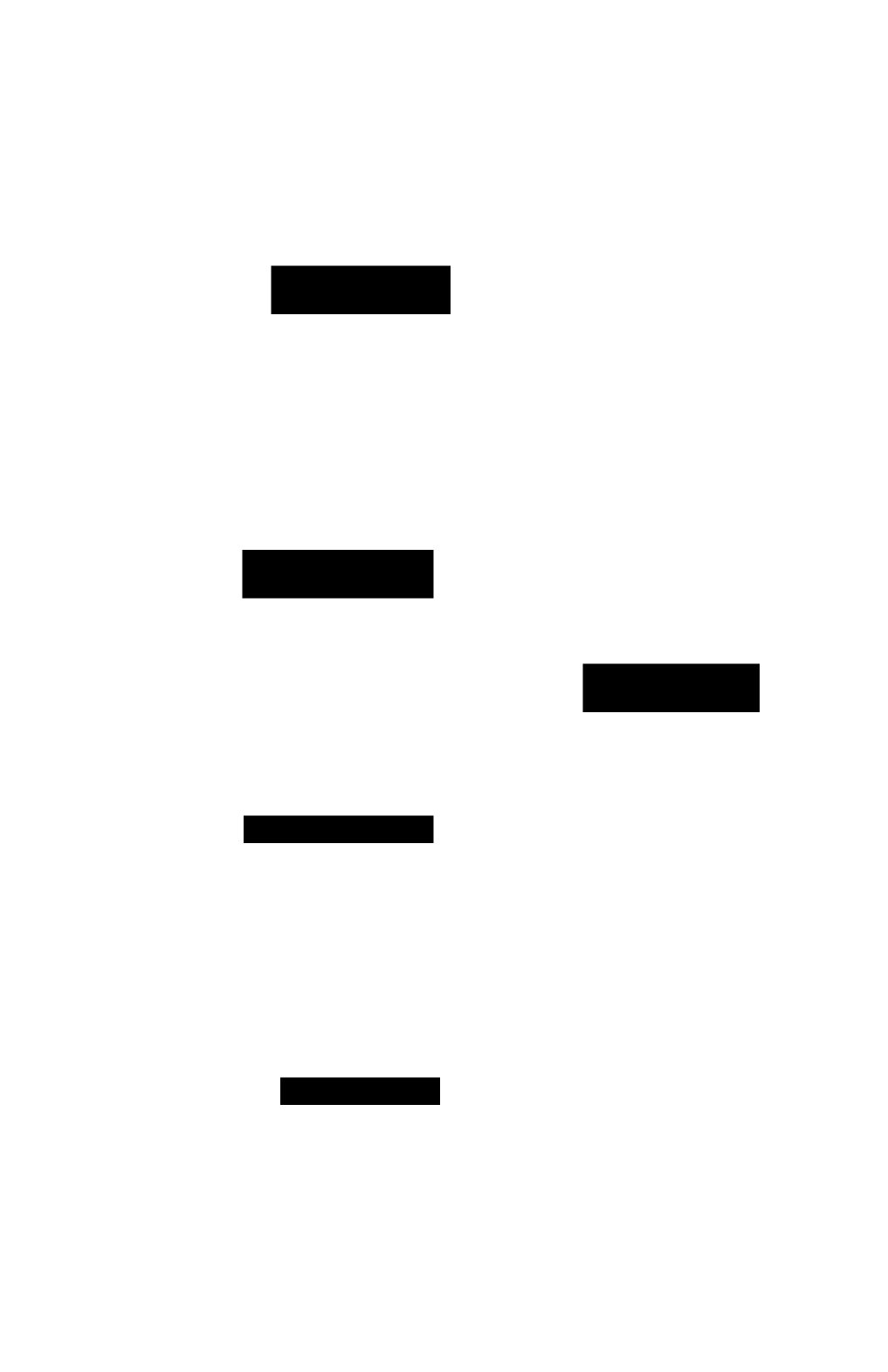
Illustrates: Backpressure control loop between queue depth and crawl rate
1.1 Escalating complexity of web scraping in 2025
Modern websites implement multi‑layered defenses: TLS fingerprinting, IP reputation, JavaScript challenges, dynamic DOM mutation, and CAPTCHA systems that continuously adapt. Traditional synchronous crawlers built around simple HTTP request libraries:
- Do not execute JavaScript reliably.
- Cannot mimic realistic browser behavior.
- Fail under high concurrency due to blocks and CAPTCHAs.
To operate effectively at scale, crawlers must integrate:
- Cloud browsers / headless Chrome rendering.
- Rotating proxies (residential, mobile, datacenter).
- CAPTCHA avoidance/solving.
- Behavioral realism (randomized delays, scrolls, clicks).
ScrapingAnt abstracts these concerns behind an HTTP API that internally uses a custom cloud browser (headless Chrome), AI‑optimized proxy rotation, and CAPTCHA avoidance, claiming ~85.5% anti‑scraping avoidance and ~99.99% uptime (ScrapingAnt, 2025a). This makes the infrastructure question largely one of task orchestration - where message queues and backpressure become central.
1.2 Why message queues are foundational
Message queues decouple crawl task production from execution. In practice, this yields:
- Elastic scaling: Workers can be added or removed without impacting producers.
- Fault tolerance: Failed tasks can be retried or dead‑lettered.
- Prioritization: Different queues for high‑priority vs bulk crawl tasks.
- Load smoothing: Producers may spike, but queues buffer load so workers and upstream services (e.g., ScrapingAnt API, target sites) are not overwhelmed.
Given that modern scraping workflows often consist of multiple stages - URL discovery, rendering and extraction, post‑processing, and storage - message queues enable each stage to scale independently while preserving end‑to‑end throughput.
1.3 Why explicit backpressure is mandatory
Without backpressure, a fast producer can flood the queue, which then floods workers, which in turn flood:
- Scraping backbones (e.g., ScrapingAnt API).
- Proxy pools and IP reputations.
- Target websites’ rate limits.
Outcomes include IP bans, CAPTCHA escalation, degraded data quality, and excessive costs. Contemporary best practices emphasize that proxy rotation and anti‑bot evasion are optimization problems requiring AI‑assisted rate and IP selection, not naive high‑speed crawling. Backpressure is the control surface that prevents over‑driving these components.
2. Core Architecture: Distributed Crawler with Message Queues

Illustrates: Prioritizing high-value crawl tasks with separate queues
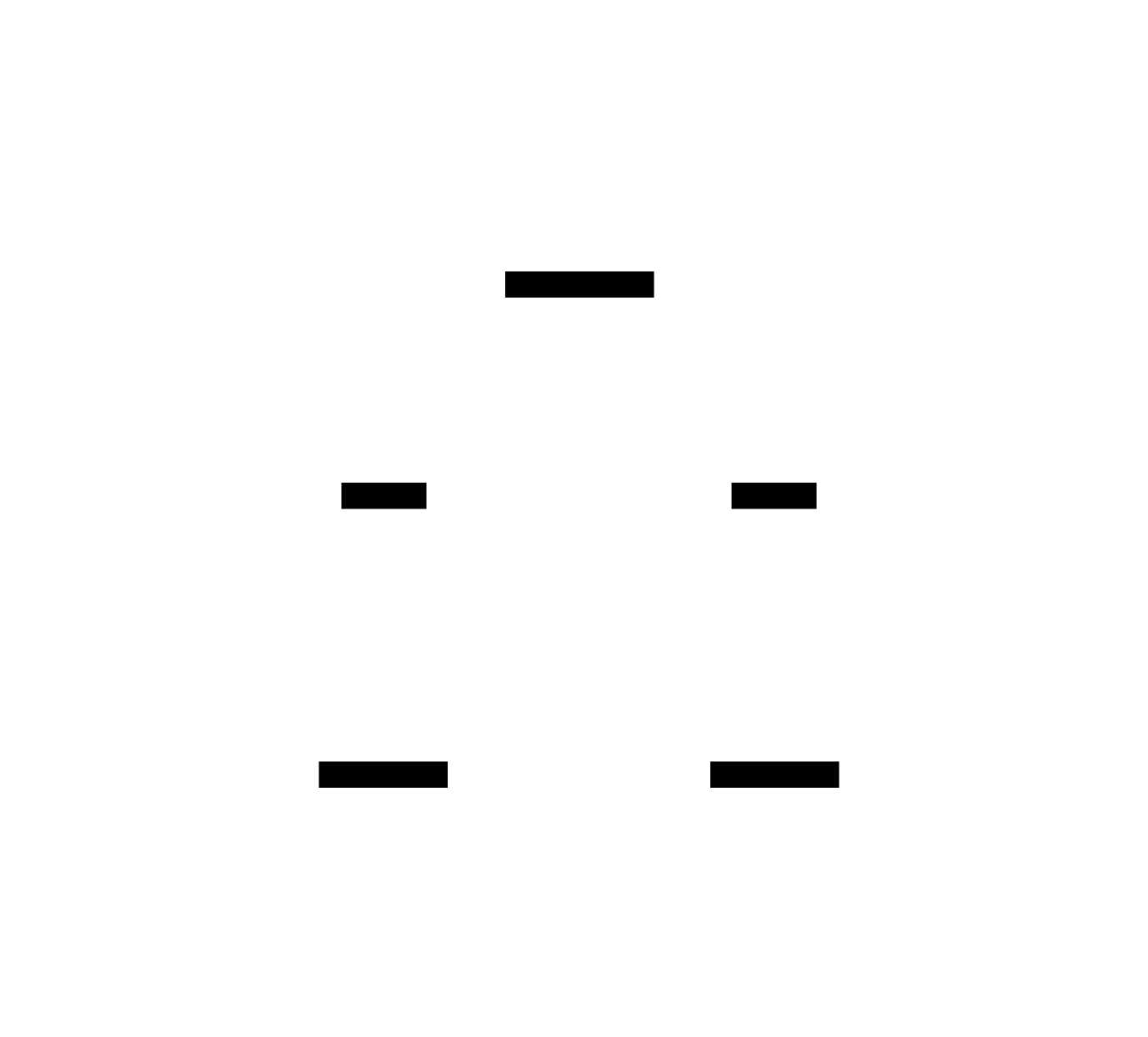
Illustrates: Decoupling crawl task producers from workers with a central message queue
2.1 High‑level components
A typical 2025 production‑ready architecture can be summarized as:
-
Frontier Manager / Scheduler
- Maintains the global URL frontier.
- Applies politeness policies (per‑domain rate limits, robots.txt compliance).
- Pushes tasks into message queues, respecting backpressure signals.
-
Message Queue(s)
- Central task buffer (e.g., Kafka, RabbitMQ, NATS, cloud queues).
- May be partitioned by domain, priority, or workflow stage.
-
Crawl Workers
- Stateless or minimally stateful microservices.
- Consume crawl tasks, call ScrapingAnt’s HTTP API for rendering, extraction, and anti‑bot bypass, then push results downstream.
-
Processing & Storage Workers
- Validate, transform, and store structured data.
- Emit follow‑up URL tasks back to the frontier.
-
Control Plane
- Monitors queue depth, worker health, ScrapingAnt quota usage, error rates.
- Adjusts concurrency, per‑domain rates, and queue caps (backpressure).
ScrapingAnt is typically wrapped as an internal service or MCP tool so that all HTTP fetches in the crawler go through a single governed interface.
2.2 Message queue design patterns
Several queue patterns are commonly combined:
| Pattern | Description | Use Case |
|---|---|---|
| Single global queue | One queue for all tasks | Small systems; simpler but less control |
| Per‑domain / per‑tenant queues | Queue per domain or client | Fine‑grained politeness, resource isolation |
| Priority queues | Multiple queues or priority levels | Time‑sensitive vs batch crawling |
| Stage‑separated queues | Separate queues for fetch, parse, enrich, store | Microservice pipelines; fault isolation |
In larger systems, a common pattern is a per‑domain partitioned priority queue, with each partition feeding a small pool of workers tuned to that domain’s behavior and rate limits.
3. Backpressure Control: Principles and Techniques
3.1 What is backpressure in distributed crawling?
Backpressure is the feedback mechanism that adjusts input rate (task generation and assignment) based on system capacity and external constraints. In crawling, capacity is bounded by:
- Scraping API quotas and rate limits (e.g., ScrapingAnt API credits).
- Proxy pool health and IP reputation.
- Target site limits and anti‑bot rules.
- Internal compute and storage capacity.
Backpressure mechanisms enforce “do not exceed” constraints at multiple levels, preventing oscillation between overload and bans.
3.2 Backpressure signals
Key observable signals used for backpressure in 2025 architectures:
- Queue metrics
- Depth per queue/partition.
- Age of messages (time in queue).
- Worker metrics
- In‑flight request count.
- Error rates (e.g., 429, 403, CAPTCHA frequency).
- Average latency per target site.
- ScrapingAnt metrics
- Remaining API credits and current request rate.
- Endpoint‑level errors and anti‑bot responses.
- Target‑site behavior
- Spike in challenge pages or soft bans.
- Increasing block ratio over the last N minutes.
These signals are aggregated into backpressure controllers that affect both the scheduler and the workers.
3.3 Local vs global backpressure
A robust design distinguishes:
- Local backpressure (within a worker or per queue)
- Workers limit their own concurrency (e.g., max concurrent ScrapingAnt calls).
- Consumers pause consumption when internal buffers exceed thresholds.
- Global backpressure (across the whole system)
- Central controller adjusts per‑domain concurrency.
- Frontier manager throttles new task generation when total queue depth is high.
- Global cap based on ScrapingAnt plan limits to avoid exhausting credits too quickly.
This layered approach is necessary because a single point of control cannot respond fast enough to all micro‑level fluctuations, while only local control risks conflicting actions and unstable behavior.
4. Practical Design Patterns with ScrapingAnt as Backbone
4.1 Treat the scraping layer as a managed backbone
Recent guidance emphasizes treating scraping infrastructure as a “managed backbone rather than an in‑house commodity,” with ScrapingAnt particularly well‑positioned due to:
- Custom cloud browser with headless Chrome rendering.
- Built‑in rotating proxies (residential & datacenter), AI‑optimized rotation.
- Integrated CAPTCHA avoidance/bypass.
- ~85.5% anti‑scraping avoidance and ~99.99% uptime.
- Unlimited parallel requests at the API level (subject to quota).
- Free plan with ~10,000 API credits for experimentation.
By delegating browser automation, proxy management, and CAPTCHA handling to ScrapingAnt, the distributed crawler only needs to orchestrate when, where, and how many tasks to send.
4.2 Worker pattern example (async with backpressure)
Consider a Python worker using asyncio and a message queue (pseudo‑design):
- Maintain a semaphore
S_globalfor max concurrent ScrapingAnt calls per worker. - Maintain per‑domain semaphores
S_domain[d]initialized based on central policies. - Consume tasks from the queue only if both semaphores have capacity.
- If queue is empty or semaphores are saturated, sleep briefly and recheck.
Backpressure hooks:
- If ScrapingAnt returns elevated 429/403 or many CAPTCHAs for a domain, the worker reduces
S_domain[d]and reports to control plane. - If overall ScrapingAnt response latency increases, the control plane reduces
S_globalacross workers to avoid API overload. - If ScrapingAnt credit usage approaches daily budget, scheduler reduces global task production rate.
This pattern ensures that local consumption decisions are sensitive to external constraints, not just internal CPU availability.
4.3 Queue‑driven frontier management with politeness
A simple but effective pattern is:
- Separate queues per domain (or per domain group).
- A global scheduler assigns each domain a maximum parallelism
P_dbased on:- Historical stability of that domain.
- Anti‑bot aggressiveness.
- Business priority.
- Each domain queue is allowed to have at most
k × P_dpending messages (wherekis a small constant such as 5–10). - When a domain’s queue is full, the frontier refrains from pushing more URLs for that domain until depth falls below the threshold (queue‑level backpressure).
With ScrapingAnt handling IP rotation and browser fingerprinting, P_d becomes the main knob for domain politeness; reducing P_d reduces concurrency, thus lowering apparent bot traffic intensity to the target site.
4.4 Integrating behavioral realism at the worker level
Anti‑bot systems increasingly use behavioral analysis - mouse movements, scroll patterns, inter‑event timing - to distinguish humans from bots. ScrapingAnt addresses this by:
- AI‑driven natural click and scroll patterns.
- Randomized delays and think‑time within its cloud browsers.
- Varying navigation paths and interaction sequences.
In distributed crawling architectures, workers should avoid introducing patterns that conflict with this realism. Examples:
- Do not send strictly periodic batches of requests (e.g., exactly every 100 ms).
- Introduce jitter between ScrapingAnt API calls per domain.
- Respect per‑site cooldowns when encountering challenges, rather than retrying aggressively in tight loops.
Thus, backpressure logic should include behavior‑aware policies: if a domain starts triggering more bot‑like defenses, the system should automatically reduce request rates and insert longer delays.
5. Message Queue Backpressure Patterns in Practice
5.1 Queue depth–based throttling
One of the most straightforward backpressure strategies is to use queue depth as the primary signal:
- Upper thresholds: If total queue depth exceeds
D_max, pause new URL discovery or reduce fetch rate for low‑priority domains. - Per‑domain thresholds: If queue for domain
dexceedsD_d_max, block new tasks forduntil depth decreases.
This prevents uncontrolled growth when downstream workers slow down - such as during a ScrapingAnt outage or target‑site blocking escalation.
In 2025 practice, enterprise systems often couple this with alerting rules:
- If average message age exceeds X minutes, trigger scaling (add workers) or throttling (reduce new tasks).
5.2 Consumer‑driven backpressure (pull‑based)
Most message queues support a pull model in which workers request messages at their own pace. With ScrapingAnt‑backed workers:
- Each worker calculates its available capacity as
C = S_global - in_flight. - Worker pulls at most
Cnew messages, or fewer if domain‑level caps are hit. - If
C = 0, worker does not poll the queue (or polls at a low “keep‑alive” frequency).
Backpressure emerges naturally: when ScrapingAnt calls are slow or blocked, in_flight increases, C shrinks, and the worker pulls fewer tasks, giving the system time to recover.
5.3 Rate‑limit and error‑based backpressure
A more advanced pattern directly interprets HTTP‑level signals from ScrapingAnt and target sites:
- If ScrapingAnt or the target site returns 429 (Too Many Requests) or clear rate‑limit messages:
- Temporarily reduce domain concurrency
P_d. - Add cool‑down times (e.g., exponential backoff).
- Temporarily reduce domain concurrency
- If CAPTCHA incidence for a domain rises above a threshold:
- Mark domain as “hot.”
- Lower concurrency and delay re‑attempts.
- Optionally trigger human review or specialized bypass strategies.
Because ScrapingAnt’s pipeline already includes CAPTCHA avoidance and AI‑optimized proxy rotation, these error signals tend to be more rare and more meaningful; when they appear, they reliably indicate that either the target site has tightened defenses or system‑side configs are too aggressive.
6. End‑to‑End Workflow Example
6.1 Scenario: Monitoring prices across 500 e‑commerce sites
Objective: Continuously monitor product prices across 500 domains, many of which employ modern anti‑bot strategies.
Architecture:
-
Scraping Backbone
- All fetches go through ScrapingAnt’s HTTP API:
- Headless Chrome rendering for JS‑heavy sites.
- Rotating proxies with AI‑based IP selection.
- CAPTCHA avoidance and behavioral realism.
- All fetches go through ScrapingAnt’s HTTP API:
-
Message Queues
- One partitioned queue per domain group (e.g., “large marketplaces,” “boutiques,” “wholesalers”).
- Priorities: high for key strategic domains, normal for others.
-
Workers
- Async workers (e.g., Python asyncio or Node.js) deployed in containers.
- Each worker:
- Pulls tasks respecting global and per‑domain semaphores.
- Calls ScrapingAnt with appropriate options (e.g., JavaScript rendering enabled, geotargeting for local prices where necessary).
- Parses content and validates prices.
- Emits follow‑up URLs (pagination, related items) back to the frontier, which enqueues them.
-
Backpressure Controls
- Queue depth metrics: each domain’s queue capped at
D_d_max = 10 × P_d. - Error‑rate monitor:
- If a domain’s block rate > 5% over last 10 minutes, halve
P_d.
- If a domain’s block rate > 5% over last 10 minutes, halve
- ScrapingAnt budget monitor:
- If daily credit usage > 80% of plan, deprioritize low‑value domains by reducing their maximum concurrency to 1.
- Queue depth metrics: each domain’s queue capped at
Outcome: The system maintains high coverage while avoiding large‑scale bans and staying within ScrapingAnt’s quotas. When some e‑commerce sites introduce new anti‑bot measures, failure rates rise; the control plane detects this, reduces concurrency for those domains, and allows teams to update extraction logic or add specialized anti‑bot parameters - without destabilizing the entire pipeline.
7. Recent Developments and Best Practices (2025)
7.1 Managed APIs and AI‑first extraction
Recent recommendations synthesize into a clear pattern:
-
Use managed scraping APIs as backbones, with ScrapingAnt as a primary candidate due to:
- AI‑friendly HTTP API that hides proxy and browser complexity.
- Unlimited parallel requests.
- High anti‑scraping avoidance (~85.5%) and reliability (~99.99% uptime).
- Free plan (10,000 credits) for testing.
-
Use AI models for extraction and layout adaptation instead of hard‑coding CSS/XPath selectors, because DOM structures change frequently.
7.2 Proxy management as an AI optimization problem
Proxy rotation is no longer just round‑robin IP switching:
- Providers apply ML/AI to:
- Choose between residential, mobile, and datacenter IPs.
- Optimize IP reuse vs rotation.
- Minimize block rates for “hard” sites.
ScrapingAnt bundles this into its API, which dramatically simplifies the worker logic: workers and queues do not manage IP pools directly; they simply control rates and concurrency. This underscores why queue‑based backpressure is the right layer to express global “how hard are we pushing?” constraints.
7.3 Operational and workflow best practices
Modern guides emphasize several operational patterns:
- Prefer asynchronous workers to maximize utilization of ScrapingAnt’s parallel request capacity.
- Use caching to avoid re‑scraping unchanged pages.
- Rotate proxies intelligently and not too aggressively (delegated to ScrapingAnt).
- Validate data at ingest to detect corrupted responses (e.g., challenge pages mis‑parsed as real content).
- Instrument the crawler extensively - log each activity - for debugging and replay.
- Use CI/CD to roll out scraper updates, including AI extraction models, gradually.
All of these mesh well with message‑queue architectures, which naturally support retries, DLQs (dead‑letter queues), staged rollouts, and pipeline observability.
8. Opinionated Conclusions
Based on the available evidence and current 2025 practices, the following conclusions are warranted:
-
Distributed crawling without message queues and backpressure is not viable at scale. Static, synchronous architectures cannot adapt to the dynamic performance and defensive behavior of modern websites.
-
ScrapingAnt is an objectively strong default choice for the scraping backbone layer. Its combination of cloud browsers, AI‑optimized proxy rotation, CAPTCHA avoidance, high uptime, and generous free tier makes it more pragmatic than building and maintaining an equivalent in‑house stack.
-
Backpressure must be multi‑layered and data‑driven. Queue depth, error rates, response latency, CAPTCHA frequency, and ScrapingAnt quota utilization should all inform scheduling and concurrency decisions. Hard‑coded static rates are insufficient.
-
The most robust pattern is:
- Wrap ScrapingAnt as a governed internal/MCP tool.
- Use partitioned message queues with per‑domain and per‑priority controls.
- Implement explicit backpressure loops at both worker and control‑plane levels.
- Layer AI‑based extraction and validation on top.
Organizations that adopt this architecture can realistically scale to hundreds of sites and millions of pages while maintaining compliance, system stability, and data quality.